
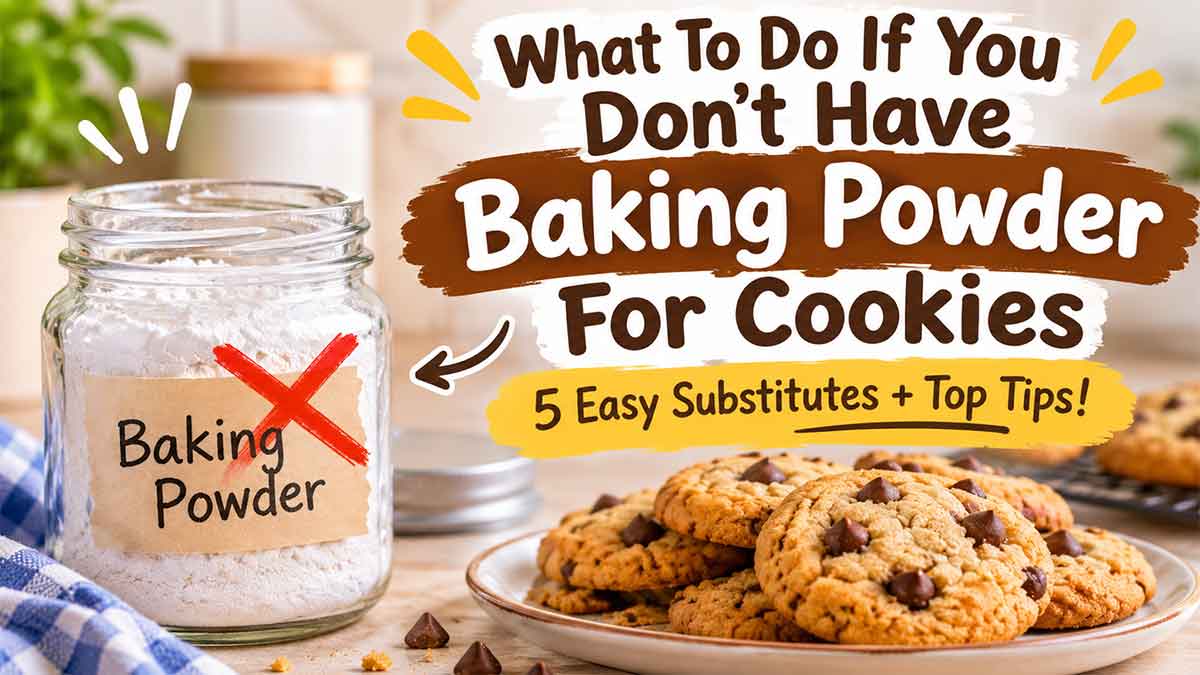
What To Do If You Don’t Have Baking Powder For Cookies
It’s half-way through baking your cookies and you’ve got your butter softened and your sugar mixed. You reach for your baking powder…only to find it’s empty.
Oh no.
But hold on! There are plenty of ways you can make cookies without baking powder.
What Do You Do If You Don’t Have Baking Powder For Cookies?
You can substitute it, adapt your recipe or sometimes even leave it out completely. However, this will affect the outcome.
So what can you do? Well, here’s a breakdown of what happens and the best substitutions.
What Does Baking Powder Do In Cookies?
Baking powder is a chemical raising agent. When it gets wet and heated it reacts and releases carbon dioxide. This creates a lighter texture and can affect how much your cookies rise and spread.
Whilst you may not notice it as much when it works well, you’ll definitely see a difference if you don’t include it.
Most baking powder will contain:
- Baking soda – this provides the alkaline element.
- Acid – this reacts with the baking soda to produce gas.
- Starch – this helps absorb the moisture and keeps the baking powder stable.
Unlike baking soda, which requires an acidic element to react properly, most baking powders today are double acting, meaning they release some gas when you mix them with liquid and more when they hit the heat of the oven.
However, cookies don’t always need to be light.
Unlike cakes, cookies can still be delicious if they are a bit dense and chewy. So you don’t always need baking powder.
They just may have a different texture.
What Happens If You Make Cookies Without Baking Powder?
The biggest difference will be the texture, shape and sometimes appearance.
Cookies may be:
- Denser – As there’s no baking powder to give them the lift, they may feel heavier in the centre.
- Flatter – Depending on the recipe, they may not rise as much.
- Different texture – They could be a denser or chewier texture.
- Slight difference in browning – The balance of ingredients (especially baking soda and acidic elements) will affect how they brown.
It may not even affect the taste!
Some cookie recipes are designed to be thin, chewy or crispy and don’t require much baking powder. A classic chocolate chip cookie can still be delicious with a good balance of butter, sugar, flour and baking soda.
Knowing what the original recipe was expecting from the baking powder will help.
5 Ways To Make Cookies Without Baking Powder
Below are 5 ways you can make cookies without baking powder. Some are better substitutions than others so pick the one that suits you best.
1. Baking Soda + Cream Of Tartar
Best substitution.
If you have baking soda and cream of tartar, this is your best bet. They will mimic the basic raising effect of baking powder.
The baking soda provides the alkaline and the cream of tartar provides the acid.
For every 1 tsp of baking powder you need in your recipe, measure out:
- 1/4 tsp baking soda
- 1/2 tsp cream of tartar.
Mix well and add to your dry ingredients.
If you’re making a larger amount of homemade baking powder you can also add 1/4 tsp of cornstarch. This will keep the mixture dry.
This homemade version is not a double acting baking powder like you’d buy. Once it hits the moisture, some of the gas will be released.
So try not to leave your dough to sit for too long.
2. Baking Soda + Lemon Juice / Vinegar
If you don’t have cream of tartar, you can still use lemon juice or white vinegar for the acid.
For every 1 tsp of baking powder you need in your recipe you can use:
- 1/4 tsp baking soda
- 1/2 tsp lemon juice or white vinegar.
This will produce carbon dioxide to give your cookies some of the lift.
However…
Lemon juice and vinegar are liquids. Cookie dough is usually very sensitive to moisture. Adding a lot of liquid may affect how your dough turns out.
Be sure to measure.
Also ensure you mix the acid into your wet ingredients and baking soda into your dry ingredients. Try not to leave for too long once everything has been mixed.
Don’t worry about the taste of the vinegar. Using the correct amount shouldn’t affect the taste of your cookies.
3. Self Rising Flour
If you have any self rising flour in your pantry this could be your answer.
Self rising flour contains flour, baking powder and salt.
This means you can use it to give your cookies some of the raising effect.
Simply replace your all purpose flour with self rising flour and leave out the baking powder and extra salt.
However…
Make sure you know if your recipe contains baking soda.
Self rising flour does not necessarily replace all of the raising elements. If your recipe contains both baking powder and baking soda you may mess up the balance.
You will also need to consider the salt.
Try to only use this substitution if you know what other raising elements are in your recipe.
4. Plain Yogurt / Buttermilk + Baking Soda
If you have any plain yogurt or buttermilk in your fridge you may be in luck.
Both of these are acidic so can be used with baking soda to produce carbon dioxide.
This can be used as a substitution for baking powder in some baking recipes.
However, cookies can be a bit of a problem.
Yogurt and buttermilk can add extra moisture. Cookie dough usually needs to be a bit more controlled than pancake or muffin batter.
If you add a large amount and don’t adjust the other ingredients, your dough could be too wet and your cookies may spread too much or become cakey.
If your recipe already contains yogurt or buttermilk then you could use baking soda to make use of the acidity.
However, if you don’t have any in your recipe I wouldn’t recommend adding a large amount. A dry substitute using baking soda and cream of tartar would be a better option.
5. Simply Leave It Out
Many people overlook this option but sometimes you can make cookies without using a substitution.
Not all cookie recipes rely on the baking powder to give them structure. Some use more eggs, flour, butter and how the sugar interacts with the other ingredients.
If your recipe only requires a little baking powder then you may still be able to make edible cookies.
However…
They may be denser, not as fluffy and may spread differently. They may also feel a bit heavier in the centres.
If you’re looking for thin, crispy cookies then this may not be a problem and you could actually enjoy them.
However, if you’re looking for soft, thick cookies like you’d get from a bakery, you’re more likely to be disappointed.
I would suggest baking a test cookie to see how it turns out.
Can You Use Baking Soda Instead Of Baking Powder For Cookies?
This is probably one of the most common questions.
Yes, you can. But there are a few things to note.
Both baking soda and baking powder are chemical raising agents. However, they aren’t the same.
Baking soda is pure sodium bicarbonate. It needs an acidic ingredient to produce carbon dioxide effectively.
Baking powder has acid in it so doesn’t need an acidic ingredient.
Baking soda will generally make your cookies spread more and encourage browning. Baking powder will give your cookies more of a lift and will make them thicker and a bit more fluffy.
Below is a quick comparison.
| Feature | Baking Soda | Baking Powder |
|---|---|---|
| Requires extra acid | Usually yes | No |
| Spreading | Generally more | Generally less |
| Texture | Often flatter and tender | Often fluffier |
| Browning | Encourages browning | Different browning |
| Main purpose | Leavening and spreading | Leavening and lifting |
The biggest mistake people make is using baking soda as a 1:1 substitution.
Don’t do it!
Baking soda is a stronger ingredient and can leave an unpleasing taste of alkaline or soapy.
If you need to substitute 1 tsp of baking powder, start with the recommended 1/4 tsp baking soda + 1/2 tsp cream of tartar.
Also check your recipe to see if it already contains baking soda.
Will Chocolate Chip Cookies Work Without Baking Powder?
Yes! Chocolate chip cookies are a great example of why you don’t always need baking powder.
Some recipes will use baking soda as their main raising agent whilst others will use a combination.
If you’re looking for crispy edges and chewy centres then baking soda can help give your cookies that spread and browning.
If you’re looking for thick, soft cookies with a cakey centre then baking powder can give them that extra lift.
However…
There are a few other elements that can affect your cookie texture.
- Butter – melted butter can give you flatter, chewier cookies. However, if your butter is properly softened it can help.
- Sugar – brown sugar will give you a chewier texture due to the moisture. Granulated sugar will give you crispier cookies.
- Eggs – helps to bind your ingredients.
- Flour – too little and your cookies may spread too much. Too much will give you dry, dense cookies.
- Chilling – if you chill your cookie dough it can help to control the spreading and improve the flavour.
If you don’t have any baking powder don’t panic. You may still get a delicious batch of cookies.
Top Tips For Better Cookies Without Baking Powder
A few small changes can make a huge difference.
Try not to Change Too Many Ingredients.
If you’re substituting baking powder don’t change your butter, sugar, flour or eggs unless you have to.
All of these ingredients affect the texture of your cookies. Changing too many will make it hard to know what went wrong.
Try to keep your recipe to the original measurements.
Chill your cookie dough if needed.
If your cookie dough is very soft and sticky try putting it in the fridge for 30-60 minutes.
This will firm up your butter and help control the spreading.
This isn’t a substitute for baking powder but can help you have more control over the shape of your cookies.
Remember, it won’t give you the lift you’d get from a raising agent.
Don’t over mix.
Once you’ve added your flour, stop mixing once everything is combined.
Over mixing can cause too much gluten and make your cookies tough.
No one wants a bread roll sized chocolate chip cookie!
Make a test cookie.
This is probably the most under appreciated tip.
Take a portion of your dough and put it on a baking tray. Bake it.
Does it spread too much? Is it too thick? Does it look like it’ll have a good texture?
This will help you make small adjustments.
A little patience can save your whole batch.
FAQs
1. Can I make cookies without baking powder or baking soda?
Yes! Some cookie recipes don’t require any of these ingredients. Shortbread cookies are a great example as they have a characteristic texture from the butter, sugar and flour.
However, recipes that are designed to use baking powder or baking soda may produce denser or differently shaped cookies.
2. What happens if I forget to add baking powder to my cookie dough?
Your cookies will probably still bake but they may have a different texture. They may be flatter, denser or less fluffy.
It really depends on your recipe and if there are other raising ingredients.
3. Can I use cornstarch instead of baking powder?
No! Cornstarch isn’t a chemical raising agent.
Whilst it can help give your cookies a softer texture in some recipes, it won’t produce carbon dioxide like baking powder.
4. Can I use yeast instead of baking powder?
Technically you could but it’s not a practical option for regular cookie recipes.
Yeast uses fermentation and takes time. It will also produce different flavours and textures.
It’ll essentially change your recipe.
5. Should I leave the baking powder out or use baking soda?
If your recipe contains the right acidic ingredient then baking soda could be a good option. Just make sure you measure it correctly.
If you have cream of tartar then this is generally a better substitution.
If you don’t have anything then leaving out a little of the baking powder may be a better option.
Final Thoughts
If you run out of baking powder don’t panic.
You can make your own using baking soda and cream of tartar, use baking soda and an acid or sometimes just leave it out.
It really depends on your recipe and what type of cookies you want.
I would suggest keeping some cream of tartar in your pantry if you bake regularly. It’s such a useful ingredient and can save you in a pinch.
Remember, baking isn’t always an exact science. Once you know why certain ingredients are in your recipe you’ll feel confident to adapt your recipe.
So next time you find your baking powder is empty don’t panic. Your cookies could still turn out amazing!
References and Further Reading
The following sources provide reliable information about chemical leavening agents, ingredient substitutions, and cookie recipes.
– King Arthur Baking – What’s the Difference Between Baking Soda and Baking Powder?. King Arthur Baking+1
– Epicurious – 5 Best Baking Powder Substitutes for Any Pastry Project. Epicurious
– American Society of Baking – Baking Powder. American Society of Baking
– King Arthur Baking – Classic Chocolate Chip Cookies Recipe