What Would Happen If Germany Won World War 1?
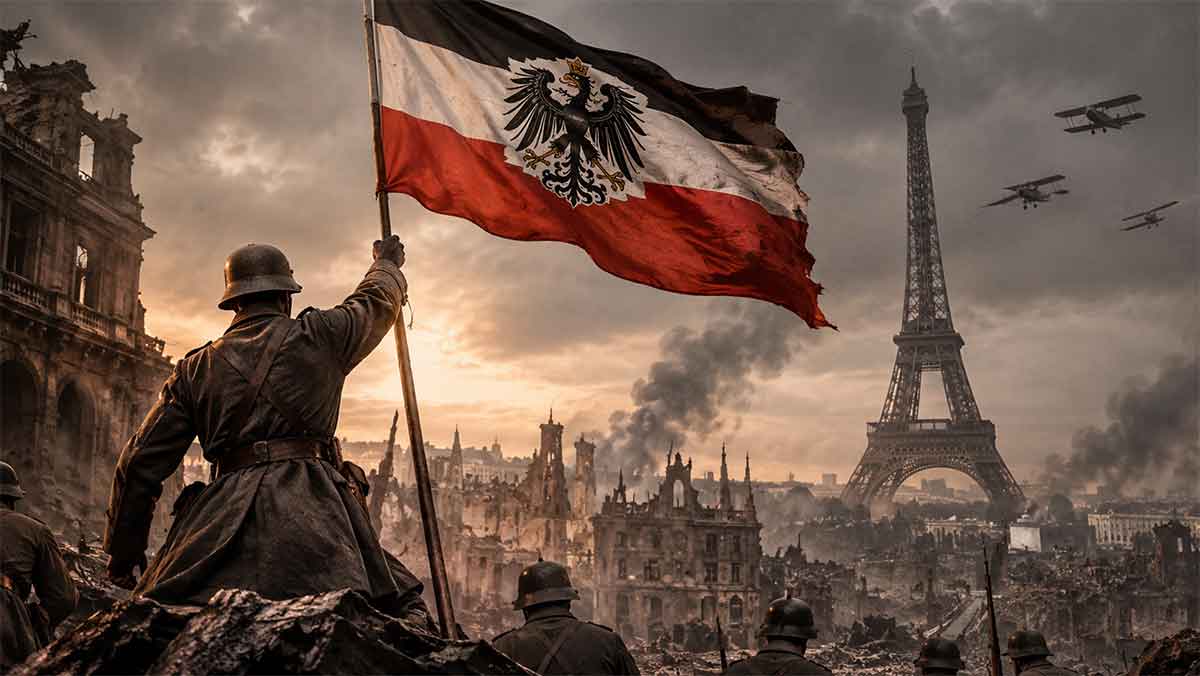
Imagine waking up in a world where Germany, not the Allied Powers, emerged victorious from World War I. There was no Treaty of Versailles forcing Germany to accept responsibility for the war. No Nazi Germany as we know it. No familiar political map of modern Europe. And perhaps, most importantly, no World War II in the form we recognize today.
Sounds like an entirely different timeline, right?
The First World War was one of the most consequential conflicts in human history. Between 1914 and 1918, it brought down empires, redrew national borders, accelerated political revolutions, and changed how people understood warfare. But what if the Central Powers had won instead?
The question what would happen if Germany won World War 1 is more than an interesting alternate-history scenario. It forces us to reconsider how much of the modern world was shaped by Germany’s defeat in 1918.
Of course, nobody can know exactly how history would have unfolded. A German victory could have taken several forms, and even a victorious Germany would have faced serious economic, political, and social problems.
Still, by examining Germany’s actual war aims, the condition of its enemies, and the political consequences of a different peace settlement, we can build a historically grounded picture of what might have happened.
1. Germany Would Probably Become Europe’s Dominant Power
The biggest immediate consequence of a German victory would likely have been a dramatic shift in Europe’s balance of power.
Before World War I, Germany was already one of the world’s strongest industrial and military nations. Its factories, railway networks, scientific institutions, and military organization made it a serious rival to Britain and France.
A victory would have allowed Berlin to turn that military strength into political influence across the continent.
Interestingly, Germany had already considered what it wanted from a victorious peace. In September 1914, German Chancellor Theobald von Bethmann Hollweg prepared a document known as the Septemberprogramm, outlining possible territorial and economic demands.
Among the proposals were:
- Weakening France through territorial concessions and financial payments.
- Turning Belgium into a German-dependent state.
- Expanding German influence across Eastern Europe.
- Creating a Central European economic union dominated by Germany.
These were proposals, not a guaranteed blueprint for the future. Still, they reveal the scale of Germany’s ambitions.
If Germany had won, France might have lost much of its influence, Belgium could have become politically dependent on Berlin, and Germany might have emerged as the leading power on the European continent.
Think of it as a Europe where Berlin, rather than Paris or London, sets much of the political and economic agenda.
That would have been a massive change.
2. Eastern Europe Could Have Become a German Sphere of Influence
One of the most interesting consequences of a German victory would have involved Eastern Europe.
Germany had already achieved a significant victory in the east before World War I ended.
In March 1918, revolutionary Russia signed the Treaty of Brest-Litovsk with the Central Powers. The agreement forced the new Bolshevik government to surrender enormous territories and resources.
Russia lost control over large areas, including territories associated with modern Ukraine, Belarus, Poland, and the Baltic region.
The treaty represented an enormous strategic advantage for Germany. It gave Berlin an opportunity to expand its political and economic influence across Eastern Europe.
In reality, Germany’s defeat in November 1918 eventually made the treaty irrelevant.
But imagine if Germany had also won in the west.
Berlin would have had a much stronger position to maintain its influence over Eastern Europe. Countries such as Ukraine, Lithuania, Latvia, and Estonia might have developed under substantial German political, military, and economic pressure.
They could have become formally independent states while remaining heavily dependent on Germany.
This arrangement would have benefited German industry, which needed access to agricultural products, raw materials, and new markets.
For Eastern Europeans, however, the situation might have been far less exciting. Independence on paper does not necessarily mean genuine political freedom.
Germany could have replaced Russian imperial influence with its own version of regional domination.
3. The British Empire Might Have Faced a Serious Challenge
A German victory would not automatically destroy the British Empire, but it could seriously weaken Britain’s position as the world’s leading naval and imperial power.
Before and during World War I, Britain viewed Germany’s growing navy as a major strategic threat.
The British Royal Navy was central to maintaining the empire’s overseas connections, protecting trade routes, and controlling access to important shipping lanes.
Germany, meanwhile, wanted a greater international role and had ambitions to expand its colonial influence.
If Germany had defeated the Allies, Britain might have been forced to accept a peace agreement that limited its ability to challenge German power in Europe.
Several outcomes are possible:
- Britain could have lost some overseas possessions or colonial influence through negotiations.
- Germany might have regained or expanded its colonial holdings.
- German naval expansion could have continued with fewer restrictions.
- Britain’s European allies and diplomatic influence could have weakened considerably.
However, a complete German takeover of the British Empire is unlikely to be a realistic assumption.
Britain had a powerful navy, global resources, and a vast imperial network. Even after a military defeat, it would probably have remained an important international power.
The more plausible scenario is a world with two competing European powers: Britain defending its maritime interests and Germany dominating much of continental Europe.
That rivalry could have created another major international crisis within a generation.
4. Would the Russian Revolution Have Developed Differently?
Here’s where things get particularly interesting.
The Russian Revolution of 1917 was one of the defining events of the twentieth century. It ended centuries of Romanov rule and eventually led to the creation of the Soviet Union.
But would the Soviet Union have existed if Germany had won World War I?
Not necessarily.
Russia’s withdrawal from the war was closely connected to military exhaustion, economic collapse, political instability, and growing public anger toward the imperial government.
The Bolsheviks gained power partly because they promised to end Russia’s participation in the conflict.
A German victory might have made the Bolshevik government even more dependent on Berlin. Germany could have supported the continued existence of smaller states along its eastern border to prevent a powerful Russia from emerging again.
There are several possible outcomes.
Scenario A: A weaker Soviet state
The Bolsheviks survive but control a smaller territory, while Germany maintains influence over the western borderlands.
Scenario B: A different Russian civil war
German intervention and territorial losses create additional opposition to the Bolsheviks, potentially prolonging the conflict.
Scenario C: A different communist future
The Bolsheviks fail to consolidate power, and Russia eventually develops under another authoritarian or nationalist government.
None of these outcomes is guaranteed. The Russian Revolution had deep domestic causes that would not simply disappear because Germany won.
Still, a German-dominated Eastern Europe would have made the Soviet Union’s historical development considerably more complicated.
5. Adolf Hitler Might Never Have Become the Leader of Germany
This is probably the most famous question in any alternate-history discussion about a German victory.
Would Adolf Hitler have risen to power?
There is a strong possibility that his political career would have followed a completely different path.
To understand why, we need to look at what actually happened after Germany lost World War I.
The 1919 Treaty of Versailles forced Germany to accept responsibility for the war, surrender territory, reduce its armed forces, give up its colonies, and pay substantial reparations.
For many Germans, the treaty represented national humiliation.
Resentment toward Versailles, combined with economic instability and political polarization, helped create opportunities for extremist movements, including the Nazi Party.
Hitler exploited those feelings.
His political messaging focused heavily on national humiliation, restoring German power, rejecting Versailles, and blaming supposed internal enemies for Germany’s problems.
But imagine a different outcome.
Germany wins the war. The Kaiser remains in power, German nationalism celebrates victory, and the country avoids the political humiliation associated with Versailles.
Would Hitler have had the same opportunity to attract supporters?
Probably not.
The political environment that helped him gain influence would have been very different.
However, this does not mean a German victory would automatically create a peaceful or democratic Germany. Imperial Germany was already an authoritarian monarchy with limited parliamentary control over executive power.
A victorious German Empire might have continued under military and aristocratic influence.
And here’s the important distinction: Hitler’s rise was never inevitable, even in the real timeline. His eventual rise depended on multiple political, economic, and social circumstances.
A German victory might have prevented the historical conditions that helped Hitler rise, but it would not have guaranteed that Germany avoided dictatorship or political extremism.
6. World War II Might Never Have Happened in the Same Way
Let’s address the biggest question.
If Germany had won World War I, would World War II have happened?
The honest answer is that we cannot know. But the conflict probably would not have happened in the form we recognize today.
The real World War II was deeply connected to the political consequences of World War I.
Germany’s defeat, the Treaty of Versailles, the collapse of several empires, the rise of fascism, and the instability of interwar Europe all contributed to the conditions that eventually produced another global conflict.
Without a German defeat, there would have been no Versailles settlement imposed on Germany in the same way.
That removes one important source of political resentment.
But it does not remove every possible cause of war.
A victorious Germany could have created its own enemies.
France might have spent decades seeking revenge. Britain could have viewed German dominance as an existential threat. Russia might have wanted to recover territories lost in the east.
Even Germany’s allies could have become sources of instability.
Austria-Hungary, for example, faced serious ethnic and political tensions that military victory alone would not have solved.
A different European power structure could therefore have produced another major war, perhaps between Germany and Britain, Germany and Russia, or a coalition of countries determined to contain German influence.
In other words, Germany winning World War I might have prevented World War II as we know it, but it would not necessarily have prevented another world war.
7. The United States Might Have Become Less Influential in Europe
The United States entered World War I in April 1917, partly because of Germany’s unrestricted submarine warfare and the Zimmermann Telegram.
American involvement gradually strengthened the Allied position, particularly as fresh troops and resources arrived in Europe.
Germany understood the danger. Its 1918 Spring Offensive was designed to achieve a decisive victory before American military strength could fully transform the Western Front.
If Germany had managed to force an Allied surrender, America’s position in European affairs could have looked very different.
President Woodrow Wilson had promoted a vision of international cooperation, national self-determination, and a new international organization to prevent future wars.
A German victory would have seriously challenged that vision.
The United States might have focused more heavily on its own hemisphere, Pacific interests, and economic development rather than becoming deeply involved in European security.
However, America would still have possessed enormous industrial and financial power.
It would not suddenly become irrelevant. Instead, the twentieth century might have developed around a different competition between American economic influence and German political and military dominance.
The relationship between Washington and Berlin could even have become one of the defining rivalries of the century.
8. Germany Could Have Become a Colonial Superpower
Germany entered World War I with overseas colonies in Africa, the Pacific, and China.
These territories were important symbols of national prestige, but Germany wanted a much larger international role.
A victorious Germany would probably have demanded the return of its colonies, which it lost after the war in the real timeline.
There was also the possibility of expanding its colonial possessions at the expense of defeated Allied powers.
German ambitions in Africa were particularly significant. Before and during the war, German policymakers discussed expanding their African influence and potentially connecting colonial territories into a larger sphere of control.
If Germany had won, parts of Africa might have experienced an even stronger period of German imperial expansion.
For local populations, this would not necessarily have meant progress.
Colonial rule involved political domination, economic exploitation, racial discrimination, and the suppression of local resistance. A stronger German colonial empire could have extended those systems.
The modern political map of Africa might therefore have looked very different.
Countries that eventually emerged from British, French, Belgian, or Portuguese colonial territories could have experienced different borders, languages, administrative systems, and independence movements.
It is also worth remembering that colonial independence movements had their own local causes. A German victory would have changed their circumstances, not necessarily erased their desire for freedom.
9. Germany Would Still Have Faced Serious Economic Problems
Here’s something that alternate-history stories sometimes overlook: winning a war does not automatically make a country prosperous.
By 1918, Germany was exhausted.
Years of fighting had consumed enormous financial resources. Food shortages, industrial disruption, inflationary pressures, and the Allied naval blockade had placed serious pressure on German society.
Even if Germany had won, rebuilding the economy would have been a massive challenge.
The government would have needed to:
- Rebuild damaged infrastructure and restore industrial production.
- Address food shortages and improve agricultural supply.
- Support millions of soldiers returning from the battlefield.
- Manage war debts and financial instability.
- Integrate newly controlled territories into its economic system.
There would also have been a difficult political question: who would benefit from victory?
German industrialists, military leaders, aristocrats, and ordinary workers would not necessarily have shared the same priorities.
A victorious government might have rewarded powerful industrial and military interests while ordinary citizens continued to face economic hardship.
This could have created domestic unrest even without the political crisis that followed Germany’s actual defeat.
In fact, a victorious German Empire could have faced a different kind of revolution if its leaders failed to address the economic and social consequences of the war.
Military success would have solved one problem, not every problem.
10. What Would the World Look Like in 2026?
Let’s take this alternate timeline a little further.
Imagine that Germany wins a negotiated peace in 1918 or 1919, preserves its monarchy, and establishes long-lasting political and economic dominance over much of continental Europe.
What might the world look like today?
Here are some plausible possibilities:
| Area | Possible alternate outcome |
|---|---|
| Europe | Germany becomes the dominant continental power. |
| France | Remains an important country but loses some political influence. |
| Eastern Europe | Several states develop under strong German influence. |
| Russia | The Soviet Union may emerge with different borders or political circumstances. |
| Britain | Remains powerful but faces a stronger European rival. |
| United States | Its involvement in European security may develop differently. |
| Germany | The monarchy could survive longer, although political reforms remain possible. |
| Africa | German colonial influence could expand or return. |
The most interesting possibility is that the European Union, as we know it, might never have existed.
The modern European integration project developed under very different historical circumstances, particularly after the destruction of World War II.
If Germany had established a dominant economic system after World War I, European countries might have become integrated under German leadership instead.
That would not necessarily resemble today’s European Union, where member states formally cooperate through shared institutions and agreements.
It might have looked more like a German-centered economic bloc, with unequal political influence between its members.
And what about technology, culture, and everyday life?
Those changes are much harder to predict. The development of aviation, automobiles, medicine, computing, and popular culture depended on countless scientific, economic, and social developments.
A different political history would certainly have influenced those fields, but it would be misleading to claim that a German victory would automatically have produced a more technologically advanced world.
History rarely follows such a simple formula.
Could Germany Actually Have Won World War I?
Before treating this alternate timeline as a realistic possibility, we should consider whether Germany could actually have won.
The answer is yes, in principle, but it would have required several major strategic successes.
Germany’s position improved significantly after Russia withdrew from the war in 1918. German forces could transfer troops from the Eastern Front to the west, creating an opportunity for a major offensive.
The Spring Offensive initially achieved impressive territorial gains.
However, German forces failed to destroy the Allied armies or achieve their central strategic objectives. They also suffered heavy casualties and struggled with supply problems.
Meanwhile, American troops continued arriving in Europe, giving the Allies an increasingly important advantage.
For Germany to win, several things might have needed to happen:
- The Spring Offensive would have had to achieve a decisive breakthrough.
- Britain and France would have needed to lose the ability or political willingness to continue fighting.
- Germany would have needed to avoid exhausting its remaining military resources.
- The Allies might have had to accept a negotiated peace before American reinforcements became decisive.
A German victory was not impossible, but it was far from guaranteed.
And importantly, defeating the Allies militarily would have been only the beginning. Germany would then have needed to maintain a political settlement that did not create an entirely new generation of enemies.
Final Thoughts: A German Victory Would Have Changed More Than Just Europe’s Borders
So, what would happen if Germany won World War 1?
The most likely consequence would have been a Europe dominated by German political, military, and economic influence. Eastern Europe could have become a collection of German-dependent states, the British Empire might have faced a stronger rival, and Russia’s political future could have taken a completely different direction.
Adolf Hitler might never have become a major political figure, and World War II might never have happened in the way we remember it.
But there’s an important lesson here: a different winner does not automatically mean a better world.
Germany’s wartime ambitions included territorial expansion, economic domination, and political control over neighboring countries. A German victory could have replaced one set of international tensions with another.
Perhaps the most fascinating part of this scenario is not imagining a world where Germany won. It’s realizing how many things we take for granted today—including national borders, political alliances, and the balance of global power—were shaped by the outcome of a war fought more than a century ago.
History could have taken a very different road. And the world we live in today might have been almost unrecognizable.
References and Further Reading
- German Historical Museum – The September Programme of 1914
- National Park Service – The United States and the First World War
- German Federal Archives (Bundesarchiv) – The Treaty of Brest-Litovsk
- U.S. Army Center of Military History – World War I Campaigns
Note: The historical events and documents discussed in this article are factual. The proposed political outcomes are hypothetical scenarios based on Germany’s documented wartime objectives and the historical circumstances of 1914–1918.