
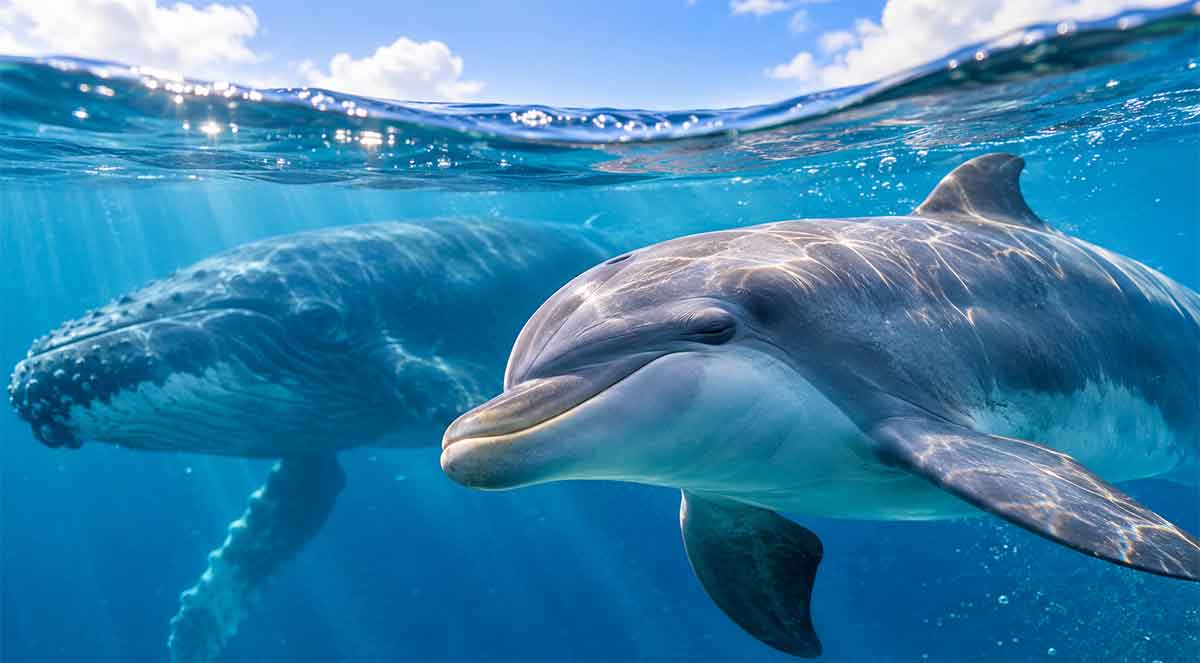
How Do Whales and Dolphins Sleep Without Drowning? The Half Brain Secret!
What if you had to sleep in the middle of the ocean? However, you couldn’t breathe automatically while you were sleeping and you had to come up for air sometimes.
This isn’t a nightmare for whales and dolphins…
Instead, these marine mammals have evolved the ability to have half their brain sleep whilst keeping the other half active enough to help them breathe, move and remain aware of what is going on around them.
This strange phenomenon is known as unihemispheric slow-Wave Sleep and is one of the most fascinating adaptations in the animal kingdom.
But how does it work? Do whales and dolphins really sleep With One Eye Open? Can they dream? And do they really have to wake up to breathe?
Let’s take a closer look.
How Do Whales and Dolphins Sleep Without Drowning?
The short answer is that whales and dolphins can put one half of their brain to sleep whilst keeping the other half awake.
This is very different to how we sleep. When we go to sleep both halves of our brain will enter different stages of sleep. Our bodies will then automatically breathe for us.
However, whales and dolphins are mammals rather than fish so they must breathe air using their lungs. They can’t extract oxygen directly from the water like fish do with gills.
They therefore have to come up to the surface to breathe through their blowhole.
They have evolved a system to help them.
What Is Unihemispheric Slow-Wave Sleep?
Unihemispheric slow-wave sleep, often shortened to USWS, is a type of sleep in which one cerebral hemisphere enters a slow-wave sleep state while the opposite hemisphere remains relatively alert.
In simple terms, one half of the brain will get some rest whilst the other half stays active.
For example, if one hemisphere (right) enters slow Wave Sleep, the opposite hemisphere (left) will be more active. After a while, the sides can swap.
This strange sleeping pattern has been observed in dolphins and other cetaceans (whales, dolphins and porpoises).
Using electroencephalography (EEG) techniques, scientists have seen differences in brain activity. A major scientific review published in Neuroscience & Biobehavioral Reviews in 2008 looked at this interesting phenomenon. It described unihemispheric sleep as a distinctive feature in cetaceans studied to date.
Research has shown that bottlenose dolphins can get around 4 hours of slow Wave Sleep per day in each hemisphere.
They don’t have to fully shut down their brain to get some rest. Clever!
Why Can’t Whales and Dolphins Sleep Like Us?
One major difference between humans and cetaceans is breathing.
Humans generally breathe automatically. Whilst we are sleeping we still have our brainstem controlling the muscles involved in breathing.
Whilst whales and dolphins do have brainstem control over breathing, it would be inaccurate to say they are breathing fully automatically. They do however have a strong link between breathing and conscious behaviour. They will have to time their breathing with coming up to the surface.
They can’t simply breathe underwater.
Dolphins will have to come up to the surface, place their blowhole above the water, blow out and then breathe.
This causes an issue.
If dolphins were to enter a sleep state where their brain activity was fully disrupted they may struggle to come up to the surface.
By having unihemispheric sleep, one hemisphere can sleep whilst the other supports the behaviours needed for breathing.
They don’t have to be fully awake but can’t afford to be fully inactive.
This is what makes their sleep so interesting.
Do Dolphins Really Sleep With One Eye Open?
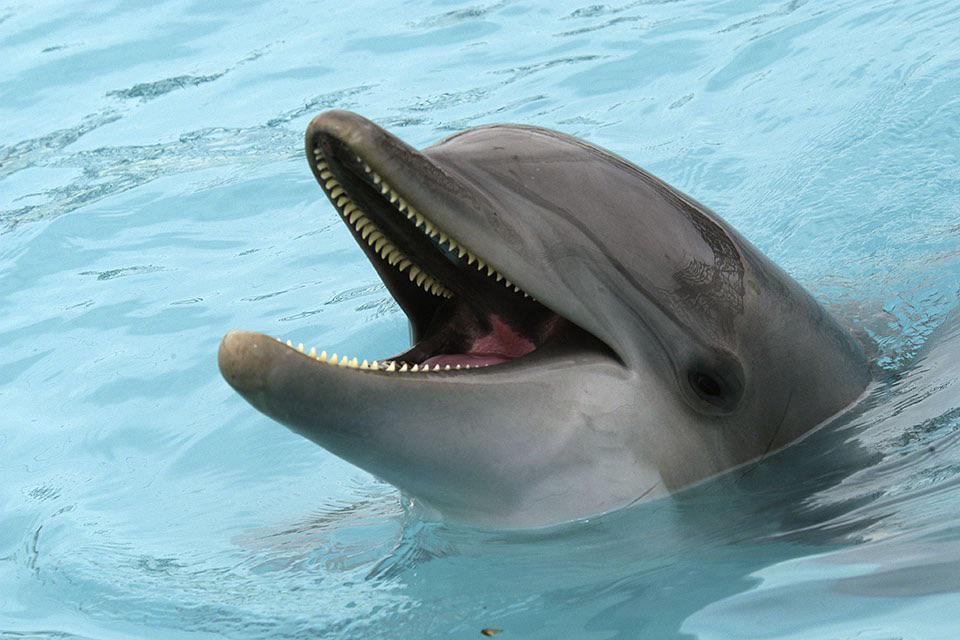
Yes! Dolphins are well known for sleeping With One Eye Open.
Generally, the eye opposite the sleeping hemisphere will be closed whilst the other eye will be open.
For example:
- If the right side of the brain is sleeping, the left eye will generally be closed.
- If the left side of the brain is sleeping, the right eye will generally be closed.
This means the dolphin can still have some awareness.
It’s like having someone on shift whilst someone else takes a break. Except both people are parts of the same brain!
Having one eye open can help dolphins to be aware of what is going on around them, stay aware of animals nearby and possibly identify any threats.
Interestingly, researchers have seen dolphins sleeping in groups. In some cases, the open eye will be facing other members of the group. This could be to help them stay coordinated with the group.
However, just because their eye is open doesn’t mean they are fully awake. Their brain is still in a sleeping state.
Where Do Whales and Dolphins Sleep?
Unlike humans, whales and dolphins don’t need a bedroom, mattress or quiet area to have a rest.
Different species will sleep in different places.
Some will float at the surface, others will move slowly and some species have been seen sleeping in unusual positions.
1. Floating At The Surface
A common behaviour for whales and dolphins is logging.
This is because they can look like floating logs.
They will generally be quite still floating horizontally with their blowhole in a position where they can easily breathe.
This means they don’t use much energy to move and can easily come up to the surface.
As they need to breathe air it makes sense for them to stay near the surface.
2. Moving Slowly
Some dolphins will continue to move whilst they sleep.
They may move slowly and steadily at the surface. This allows the active hemisphere to control their movements and breathing.
It is interesting to note that they can still move whilst they sleep.
Their brain can still be active enough to allow basic movements whilst the opposite hemisphere sleeps.
It’s like walking on auto-pilot whilst taking a mental break. Although this process is far more complex.
3. Underwater Or Near The Seabed
Some dolphins have been seen sleeping on the bottom of shallow pools or tanks.
They will come up to breathe periodically.
Whales have interesting sleeping behaviours too. Sperm whales have been seen sleeping vertically with their head up and tail down.
A 2008 study looked at these interesting sleeping patterns in wild sperm whales.
This has shown how different sleeping can be for marine mammals. There is no one sleeping position for all whales and dolphins.
How Much Do Whales and Dolphins Sleep?
There is no set sleeping pattern for all whales and dolphins.
Different species will have different sleeping patterns. Research is still being done to find out how much sleep different species need.
Bottlenose dolphins are one of the most studied cetaceans. Research has shown that each hemisphere can get around 4 hours of slow Wave Sleep in 24 hours.
Sperm whales are interesting too.
They have been seen sleeping in short bursts. Often they will sleep for around 10-15 minutes. One well known study showed they spent around 7% of the time observed sleeping in this unique way.
This is surprisingly little compared to many land mammals.
However, it would be misleading to assume all whales sleep this little. Different species will have very different sleeping times and it can be difficult to observe their sleeping behaviours.
There is still a lot to learn about how cetaceans balance their sleeping, moving, feeding and socialising.
Can Whales and Dolphins Dream?
This is where things get interesting.
Humans often have vivid dreams during REM sleep. This is when our brain becomes more active and many muscles become very inactive.
Cetaceans seem to have very different sleeping patterns.
Scientific studies have shown there is little evidence of traditional REM sleep in whales and dolphins. Some researchers have suggested they may have very little REM sleep or it may be altered.
Does this mean they can’t dream?
Not necessarily.
It can be difficult to study dreaming in animals. We can’t ask them what they dreamed.
We also can’t assume that if they don’t have obvious REM sleep they won’t have any dream like experiences.
Currently there is no definite answer from scientists as to whether whales and Dolphins Dream like humans.
It is an interesting question but more research needs to be done.
Why Did Whales and Dolphins Evolve This Unique Sleeping Ability?
Unihemispheric sleep helps solve a few issues that come with living fully in an aquatic environment.
It helps cetaceans to still coordinate their breathing and coming up to the surface whilst sleeping.
It also helps them to have some awareness whilst sleeping. This can be useful if they live in groups or in an environment where there may be threats.
It also helps them to still move.
Another reason could be to do with body temperature.
Whales and dolphins are warm blooded animals. They live in water which can cause them to lose body heat much quicker than air. Scientists have suggested that by keeping some movement whilst sleeping cetaceans can help with this.
A 2008 scientific review looked at this interesting phenomenon. It discussed how thermoregulation could be an evolutionary pressure.
Scientists don’t know everything. There may be a few factors that have caused cetaceans to evolve this unique Sleeping Ability.
We do know that sleeping in the ocean can cause some issues that land mammals wouldn’t face. Cetaceans have evolved an amazing way to overcome this.
Final Thoughts
Whales and dolphins sleeping reminds us that sleeping isn’t a one size fits all process.
Humans can shut both eyes and become largely unaware of what is going on around us. Whales and dolphins have evolved to have one hemisphere of their brain sleep whilst keeping the other active enough to help with essential behaviours.
They can sleep With One Eye Open, whilst swimming and coming up to breathe. This shows how adaptable mammal biology can be.
The most fascinating thing is that we are still learning!
The ocean is full of amazing animals but few are as fascinating as whales and dolphins taking a nap with half their brain on!
References and Further Reading
The article is based on scientific literature and educational resources from the following credible sources:
1. NOAA Fisheries – Do Whales and Dolphins Sleep?. Explains unihemispheric sleep and how cetaceans remain aware while resting.
2. Whale and Dolphin Conservation (WDC) – How Do Whales and Dolphins Sleep?. Covers sleeping behavior, breathing, and differences between species.
3. Lyamin et al. (2008) – Cetacean Sleep: An Unusual Form of Mammalian Sleep. Scientific review published in Neuroscience & Biobehavioral Reviews.
4. Mascetti (2016) – Unihemispheric Sleep and Asymmetrical Sleep: Behavioral, Neurophysiological, and Functional Perspectives. Examines the neurological mechanisms and potential functions of one-sided sleep.
5. Smithsonian Ocean – Whales and Dolphins. Provides additional information about marine mammal biology and sleeping behavior.