
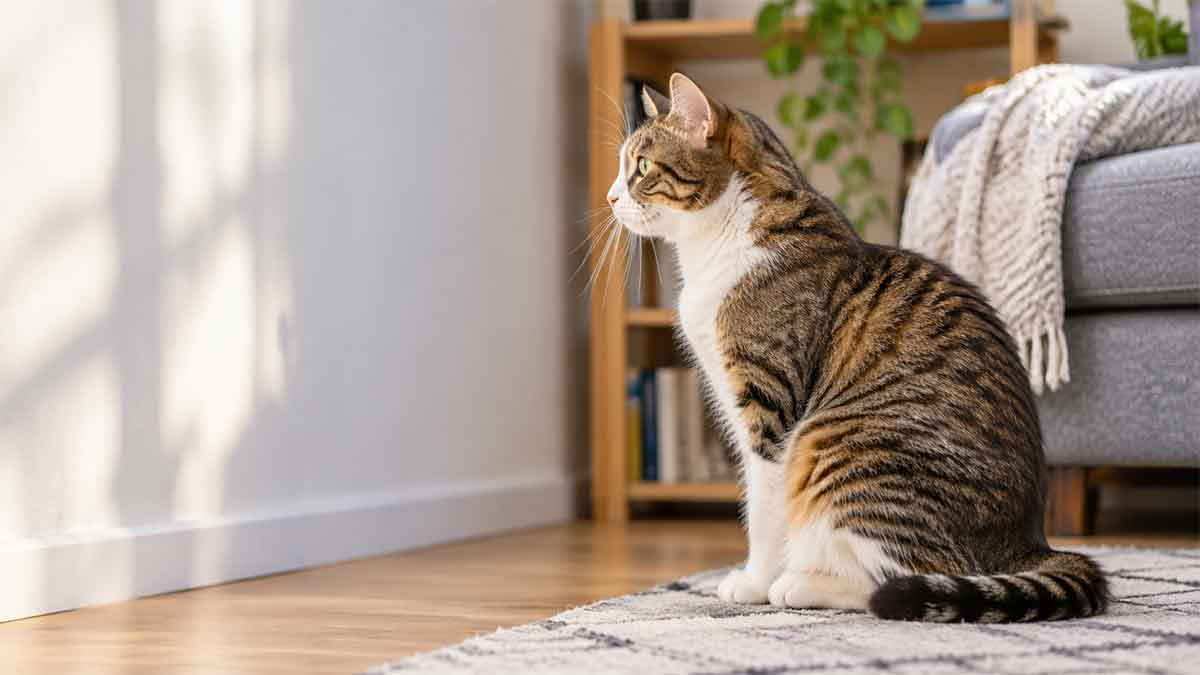
Why Do Cats Just Sit and Stare at Nothing? 7 Possible Reasons Explained
Have you ever looked at your cat and noticed them sat staring blankly into a corner of the room?
This is one of those weird little quirks that can leave you giggling, confused or wondering if they know something we don’t!
There are many jokes about cats seeing ghosts, but most people will just assume their cat is daydreaming. However there is actually more to this behaviour than you may think!
Most of the time they will be doing this because they have amazing senses, are natural predators and perceive their environment. Whilst we may see nothing interesting, they can find it very intriguing!
However there are some instances where staring into space could be an indication of an underlying health issue, especially in older cats.
We are going to look at 7 possible reasons why they may be staring into space and how you can tell if this quirky behaviour is totally normal or something to discuss with your vet.
1. Your Cat Can Hear Something You Can’t
One of the most common answers is that your cat may simply be paying attention.
Cats have excellent hearing and can hear high frequency sounds that we can’t. This means they can pick up on potential prey that may be hiding.
When your cat is sat in your living room looking at a blank wall. Whilst you may see nothing out of the ordinary your cat may actually be able to hear something. There may be a small mouse scurrying about on the other side of the wall, an insect crawling in a small crevice or a pipe making a soft clicking noise.
All of these things may be heard by your cat.
Unlike us humans, cats are very aware of the small noises that may be happening around them.
Especially if they tilt their head to one side.
Your cat may simply find your empty room fascinating!
2. Cats Notice Tiny Movements We Easily Miss
Even if they live a completely indoor life, your cat will still have some of their innate hunting behaviours.
They have excellent eyesight for identifying movement.
Even the smallest movements can make your cat take notice such as:
A little bug crawling around on the ceiling, a faint shadow or even just a speck of dust!
You might not even have noticed something moving and suddenly your cat will begin to track it.
They also have great night vision. This means their eyes are built to help them see in low light conditions. As a result they can spot very slight changes in their surroundings.
This can mean that your cat will stare at nothing for a few minutes and then suddenly pounce.
They may not actually be seeing anything but could be looking at something too small to see.
3. Their Hunting Instincts Are Kicking In
Sometimes a cat will stare blankly because of its hunting instincts.
Although they are hunters, sometimes they will stalk their target.
The cat may freeze completely when they spot something to hunt. They will watch their target to see how it moves, how far away it is and when is the best time to strike.
This is why some cats can be completely still for surprisingly long periods of time.
You may notice that your cat stares at the floor, wall or under the furniture. Then after a few seconds they will suddenly jump or start pawing.
This is their hunter instinct.
Even if your cat has never had to hunt for its dinners, these instincts are still there.
This is why even a simple feather or piece of string can turn your sleepy cat into a ball of energy.
4. Your Cat Might Simply Be Relaxing or Zoning Out
Your cat may actually be doing nothing special!
Like us, cats can sometimes zone out.
They will not always want to be entertained, interacted with or have a specific agenda.
Sometimes they may simply sit and gaze off into the distance.
You may often find yourself gazing out of the window during a relaxing afternoon. You are not looking for anything in particular, your brain is simply taking a break.
Cats can do this too!
If your cat appears calm, in a natural position, reacts when called and goes back to doing what they usually do then there really isn’t any reason to be concerned.
Not everything strange your cat does needs a complex explanation.
Sometimes they may just be enjoying a relaxing moment!
5. Something in the Environment Has Caught Their Attention
Cats are naturally curious creatures and can be easily distracted.
They can be entertained by things we do not even notice like:
A reflection on your phone screen, sun reflecting off the window, a flickering TV screen or a shadow.
You may notice your cat staring at the same spot on a wall or ceiling.
Before assuming something weird is going on take a look around.
Check for:
- Small reflections from mirrors, windows and electronic screens.
- Shadows moving from trees and passing cars.
- Insects hiding near the ceiling, windows or corners.
- Strange noises from appliances or other rooms.
- Changing light patterns throughout the day.
Cats are amazing at noticing changes in their surroundings. What we see as nothing could be interesting from their perspective.
Don’t make a mystery out of your living room but sometimes looking around can help you figure out what is going on.
6. Older Cats May Experience Cognitive Changes
While occasional staring is usually harmless, persistent staring in older cats deserves a little more attention.
As cats age, they can develop a condition called feline cognitive dysfunction syndrome (CDS). It’s a form of age-related cognitive decline that can affect memory, awareness, sleep patterns, and everyday behavior.
According to the Cornell Feline Health Center, cats experiencing cognitive dysfunction may spend long periods staring blankly into space or at walls.
Other possible signs include:
- Becoming confused in familiar surroundings.
- Wandering around without an obvious purpose.
- Sleeping more during the day and staying awake at night.
- Vocalizing excessively, particularly during nighttime.
- Losing interest in familiar activities.
- Forgetting familiar routines, such as where the food bowl or litter box is located.
These changes are generally more noticeable in cats around 10 years of age or older.
However, age alone doesn’t automatically mean your cat has cognitive dysfunction.
Other medical conditions, including high blood pressure, kidney disease, thyroid problems, and neurological disorders, can also affect behavior in senior cats.
If your older cat has suddenly started staring at walls or seems confused in familiar places, arranging a veterinary examination is a sensible step.
Early evaluation can help identify problems that may be manageable with appropriate care.
7. Sometimes, Staring Can Be a Sign of a Medical Problem
This is the part cat owners shouldn’t ignore.
Although staring into space is often a harmless behavior, unusual episodes can occasionally be associated with neurological or other medical conditions.
For example, certain seizure disorders can cause changes in awareness. A cat might suddenly stop what it’s doing, stare into space, or appear disconnected from its surroundings.
Other possible warning signs include:
- Unusual facial or body twitching.
- Repeated episodes of staring with little or no response.
- Sudden loss of balance or coordination.
- Excessive drooling.
- Unusual movements or repetitive behaviors.
- Sudden changes in appetite or activity levels.
Another important behavior to recognize is head pressing.
This is different from simply looking at a wall. A cat that persistently presses its forehead against a wall, corner, or other hard surface may be experiencing a serious neurological or metabolic problem.
Head pressing requires urgent veterinary attention.
If your cat experiences a seizure, collapses, becomes suddenly disoriented, or shows other serious neurological signs, seek emergency veterinary care.
Never assume that a sudden change in behavior is simply another funny cat habit.
How to Tell Whether Your Cat’s Staring Is Normal
So, how do you know whether your cat is simply being a cat or whether something might be wrong?
The best approach is to look at the entire behavior rather than focusing only on its eyes.
Pay attention to what happens before, during, and after the staring episode.
For example, a healthy cat might sit quietly, focus on a particular spot, twitch its ears, and eventually walk away when something catches its attention.
A more concerning situation involves a cat that repeatedly stares into space, seems confused, doesn’t respond normally, or displays other unusual physical symptoms.
Here’s a simple comparison:
| Normal behavior | Potential warning signs |
|---|---|
| Briefly staring at walls or ceilings | Repeated prolonged staring episodes |
| Responding to familiar sounds | Appearing unusually unresponsive |
| Relaxed body posture | Sudden stiffness or unusual movements |
| Returning to normal activities | Confusion or disorientation |
| Occasionally watching shadows | New or worsening behavior changes |
One useful tip is to record a video when the behavior happens. Cats don’t always repeat unusual behaviors during veterinary appointments, so having a recording can help your veterinarian understand what’s happening.
Also, pay attention to how frequently it occurs and whether anything else has changed.
Should You Stop Your Cat From Staring at Nothing?
In most cases, no.
If your cat is healthy, relaxed, and behaving normally, there’s no reason to interrupt every staring session.
Let your cat enjoy its little moments of curiosity.
However, you can make its environment more interesting by providing interactive toys, scratching posts, climbing spaces, and opportunities to explore safely.
Regular playtime is particularly helpful because it gives indoor cats an opportunity to express their natural hunting instincts.
Try using a feather wand or a toy that moves unpredictably. Allow your cat to chase, stalk, and occasionally catch its target.
For older cats, maintaining a predictable daily routine and providing comfortable resting spaces can also make everyday life easier.
Most importantly, learn your cat’s normal behavior. When you understand what’s typical for your pet, unusual changes become much easier to recognize.
Frequently Asked Questions
Do cats see ghosts when they stare at nothing?
There’s no scientific evidence that cats can see ghosts. Their impressive hearing, vision, and sensitivity to movement provide much more ordinary explanations for this behavior.
What looks like an empty corner to you might contain a tiny insect, a moving shadow, or a sound that your cat has noticed.
Why does my cat stare at the wall for so long?
Your cat may be watching a tiny movement, listening to something behind the wall, or simply resting its attention on one spot.
However, persistent staring accompanied by confusion, disorientation, or other behavioral changes should be discussed with a veterinarian.
Why does my cat suddenly stare at the ceiling?
Cats can notice reflections, insects, subtle shadows, and sounds coming from above them. Their natural hunting instincts also make them particularly interested in small movements.
Sometimes, the explanation is something as simple as a fly near the ceiling.
Is it normal for kittens to stare at nothing?
Yes. Kittens are naturally curious and are constantly learning about their surroundings.
They may spend time watching shadows, tracking tiny movements, or investigating unfamiliar sounds. As long as they’re otherwise active, eating, and behaving normally, occasional staring is generally not concerning.
Why does my cat stare at nothing at night?
Cats are naturally active around dawn and dusk, although individual sleeping patterns vary.
At night, a quieter environment may make faint sounds and subtle movements easier for them to notice. Your cat might also become more interested in exploring when the household settles down.
Final Thoughts
Why do cats stare?
Most of the time it will be down to their amazing sense, natural instinct to hunt, or curiosity.
They see things differently to us and will be drawn to sounds, movement and things in their environment which we may never even notice.
This can make them very entertaining to have around.
However, if your cat is suddenly doing something different or staring for long periods of time, being confused, doing odd things or pushing their head into things then you should take note.
While it can be fun to watch your cat do their mysterious things, it is also important to look at the bigger picture. Sometimes knowing what is normal for your cat can help you provide the best care for them.
References for factual accuracy
The article’s health and behavior information is informed by these veterinary resources: