
If the Moon suddenly crashed into Earth, the result would be a global catastrophe powerful enough to wipe out nearly all life on the planet. The collision would release more energy than billions of nuclear bombs exploding at the same time. Oceans would boil, continents would crack apart, and massive clouds of debris would cover the atmosphere for years. In reality, this event is extremely unlikely, but scientists have studied similar cosmic impacts to understand how destructive they can be.
The idea of what would happen if the moon hit earth sounds like science fiction, yet it raises real questions about gravity, planetary motion, and survival on Earth. Because the Moon controls ocean tides and helps stabilize Earth’s rotation, even a small change in its orbit could create serious problems long before any impact happened.
Table of Contents
Could the Moon Actually Crash Into Earth?
Under normal conditions, the Moon is slowly moving away from Earth at about 3.8 centimeters per year. That means it is becoming more distant, not closer. So a direct collision is almost impossible naturally.
However, if a giant asteroid, rogue planet, or another cosmic event disrupted the Moon’s orbit, the situation could change dramatically. Once gravity pulled the Moon toward Earth, there would be no way to stop it. The closer it moved, the stronger Earth’s gravity would become.
Before impact even happened, the planet would already begin suffering major destruction.
What Happens Before the Collision?
Extreme Tides Would Destroy Coastlines
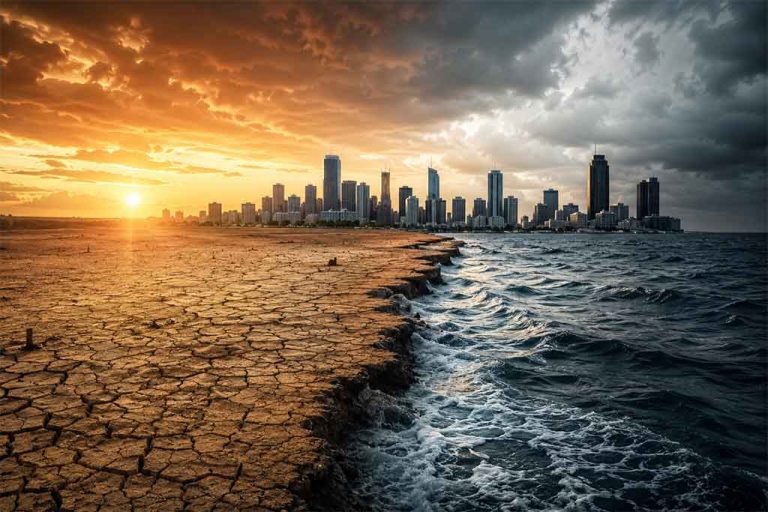
One of the earliest signs would be gigantic tides. Since the Moon controls Earth’s tides, a closer Moon would create enormous tidal waves hundreds of feet high. Coastal cities around the world would disappear underwater.
Countries with large coastlines would face nonstop flooding. Hurricanes and storms would become stronger because ocean temperatures and atmospheric conditions would become unstable.
If you are curious about how important the Moon already is for our planet, you can also read what would happen if the Moon disappeared, which explains how Earth would change without lunar gravity.
Earthquakes and Volcanoes Would Increase
As the Moon moved closer, its gravitational pull would stretch Earth’s crust. This pressure could trigger powerful earthquakes and volcanic eruptions across the globe.
Massive fault lines like the San Andreas Fault could rupture repeatedly. Volcanoes that have been dormant for centuries might suddenly erupt. Ash clouds would darken the sky and damage agriculture worldwide.
The Moment the Moon Hits Earth
The actual impact would be beyond anything humans have ever experienced. The Moon is about 3,474 kilometers wide, making it far larger than the asteroid believed to have killed the dinosaurs.
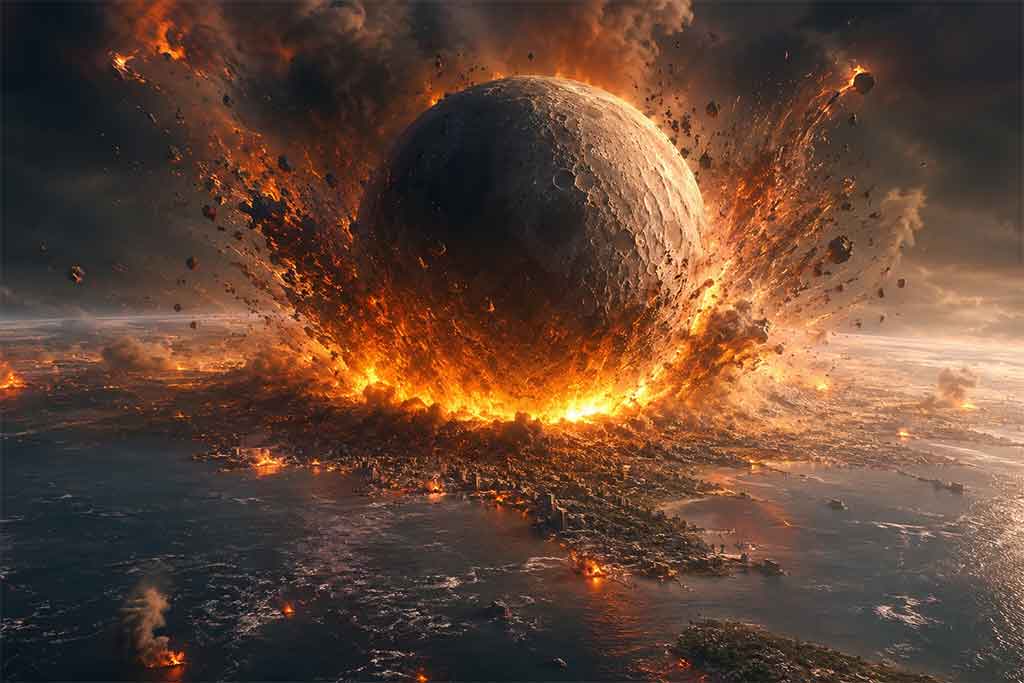
When the collision happened, the energy release would instantly melt huge parts of Earth’s surface. Entire continents near the impact zone would vaporize within seconds.
A Firestorm Across the Planet
The impact would throw molten rock and debris into the atmosphere. As this material fell back to Earth, temperatures worldwide would rise dramatically. Forests would ignite almost instantly.
The sky would glow red from heat and fire. Shockwaves traveling around the planet would flatten cities thousands of miles away from the collision site.
The Oceans Would Boil
The heat from the impact would likely boil large portions of Earth’s oceans. Steam would fill the atmosphere, creating deadly conditions for most living organisms.
Marine ecosystems would collapse quickly. Fish, coral reefs, and ocean plants would struggle to survive in overheated and chemically altered water.
Would Humanity Survive?
The chances of human survival would be extremely low. Modern civilization depends on stable temperatures, food supplies, electricity, and communication systems. A Moon collision would destroy all of those almost immediately.
Even people far from the impact zone would face long-term problems:
- Global food shortages
- Toxic air pollution
- Extreme climate changes
- Nuclear winter conditions
- Loss of sunlight from dust clouds
Some underground shelters might protect small groups temporarily, but surviving for years would be difficult. Farming would become nearly impossible if sunlight stayed blocked by debris.
Would Earth Be Completely Destroyed?
Earth probably would not explode completely, but the planet would be heavily damaged. Scientists believe a collision between Earth and another Mars-sized object billions of years ago may have helped form the Moon itself.
In this hypothetical scenario, Earth’s surface would likely become partially molten again. Huge sections of the crust could break apart. The atmosphere would change drastically, and the environment could become hostile to most current life forms.
Some researchers think the collision could even create a new ring system around Earth from floating debris.
How Does This Compare to Other Moon Scenarios?
Many people wonder about different lunar disaster theories because the Moon plays such a critical role in Earth’s balance. For example, what would happen if the Moon exploded explores a different but equally terrifying scenario involving lunar fragments raining onto Earth.
Both situations would severely affect gravity, climate, and survival. However, a direct collision would likely cause far greater destruction in a shorter amount of time.
How Long Would It Take for Life to Recover?
If any life survived, recovery would take millions of years. Earth has recovered from mass extinctions before, but the process is incredibly slow.
After the dinosaurs disappeared, ecosystems needed millions of years to stabilize again. A Moon impact could create even harsher conditions.
Simple organisms like bacteria might survive underground or deep in the oceans. Over time, evolution could eventually create new ecosystems.
The world after such a disaster would look completely different from modern Earth. In some ways, it might resemble the lonely landscapes imagined in what Earth would look like if humans disappeared tomorrow, except with far more destruction and environmental chaos.
Why the Moon Matters So Much
The Moon does more than light up the night sky. It stabilizes Earth’s tilt, influences tides, and affects natural cycles across the planet. Without it, Earth would behave very differently.
That is why discussions about what would happen if the moon hit earth remain fascinating. The scenario highlights how connected our planet is to the objects surrounding it in space.
Fortunately, scientists have found no evidence suggesting the Moon is on a collision course with Earth. For now, humanity can safely enjoy the Moon from a distance instead of worrying about a planetary disaster.