
If the Moon suddenly exploded, Earth would not be instantly destroyed—but life as we know it would change dramatically. The night sky would turn into a storm of debris, tides would become chaotic, and over time, the planet’s stability could collapse. In short, the Moon’s destruction wouldn’t wipe us out immediately, but it would slowly reshape Earth in dangerous and unpredictable ways.
This scenario sounds like pure science fiction, but understanding what would happen if the Moon exploded actually reveals how important it is to life on Earth. From stabilizing our planet’s tilt to controlling ocean tides, the Moon plays a much bigger role than most people realize.
Table of Contents
The Immediate Aftermath of a Moon Explosion
The most important thing to know is this: if the Moon exploded, its gravity wouldn’t just disappear. The debris would still carry the same mass, meaning Earth wouldn’t suddenly drift off into space.
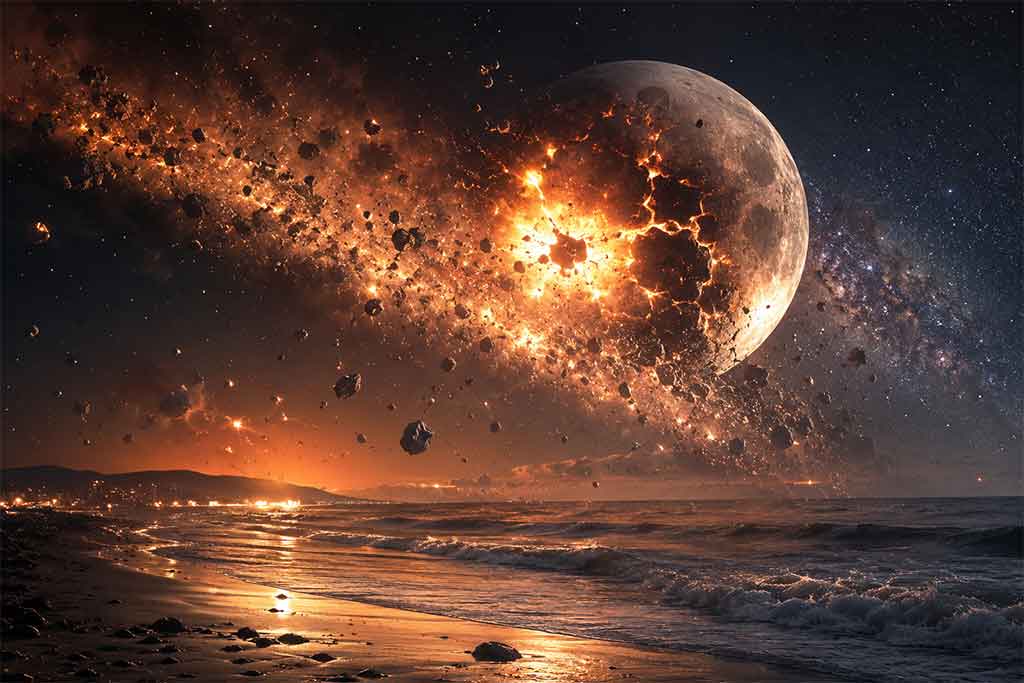
Right after the explosion, the Moon would break into billions of pieces. These fragments would spread out into a massive debris cloud orbiting Earth. For a short time, the sky would glow with scattered light, almost like a permanent meteor shower.
Some chunks would start falling toward Earth within days or weeks. Smaller debris would burn up in the atmosphere, but larger pieces could survive the descent, causing regional damage. It wouldn’t be a single extinction-level event, but repeated impacts over time could become a serious threat.
Would Earth Be Hit by Moon Debris?
Yes—but not all at once.
Most of the Moon’s fragments would remain in orbit for a long time, forming a temporary ring system around Earth, similar to Saturn’s rings. Over time, gravity would slowly pull some of that debris inward.
This means Earth could experience periodic meteor impacts for thousands of years. These impacts wouldn’t necessarily wipe out humanity, but they could disrupt ecosystems, climate patterns, and infrastructure.
Think of it like a slow-motion disaster instead of a sudden apocalypse.
How the Sky Would Change Forever
One of the most noticeable effects of what would happen if the Moon exploded is the sky itself.
Instead of a single bright Moon, you’d see a glowing band of debris stretching across the night sky. It would look beautiful at first—almost like a cosmic halo—but it would also be a constant reminder of instability.
Over time, as debris either falls to Earth or escapes orbit, the sky would slowly darken again. Eventually, the Moon would be completely gone.
The Impact on Ocean Tides
The Moon controls Earth’s tides. Without it, things would get messy.
Right after the explosion, tides would become chaotic due to the uneven distribution of lunar debris. Some areas might experience extreme tidal swings, while others could see reduced activity.
Eventually, as the debris disperses, tides would weaken significantly. The Sun would still influence tides, but they would be much smaller—about one-third of their current strength.
This change would disrupt marine ecosystems, especially coastal environments that rely on regular tidal patterns.
Climate and Earth’s Stability
The Moon plays a key role in stabilizing Earth’s axial tilt. Without it, the planet could begin to wobble over long periods of time.
This wobble wouldn’t happen overnight. It would take thousands to millions of years. But eventually, Earth’s climate could become far more extreme.
Seasons might shift unpredictably. Some regions could experience intense heat, while others might plunge into deep cold. Over time, this instability could make Earth less hospitable for life.
If you’ve ever wondered how fragile systems can be, it’s similar to scenarios like what Earth would look like if humans disappeared tomorrow, where small changes lead to massive long-term transformations.
Would Gravity Change?
No, Earth’s gravity wouldn’t suddenly change.
The Moon’s mass would still exist, just in smaller pieces. As long as those pieces remain in Earth’s orbit, their combined gravitational effect would be similar to the Moon’s original pull.
However, as debris slowly escapes or crashes into Earth, that gravitational influence would gradually decrease. This would further weaken tides and contribute to long-term instability.
What About Earth’s Rotation?
The Moon also helps regulate Earth’s rotation.
Without it, the length of a day could slowly change over millions of years. Right now, the Moon’s gravitational pull slightly slows Earth’s rotation. Without that braking effect, the planet could spin a bit faster.
This wouldn’t be noticeable in your lifetime, but over geological timescales, it could alter weather systems and climate patterns.
Could Life Survive?
Yes—but it wouldn’t be easy.
Life on Earth is incredibly resilient. Even with meteor impacts, weaker tides, and climate shifts, many forms of life would survive.
However, human civilization could struggle. Coastal cities might face flooding or ecological collapse. Agriculture could be affected by shifting seasons. And the constant threat of debris impacts would create long-term risks.
It’s a bit like other “what if” scenarios, such as what would happen if mosquitoes went extinct, where removing one element from Earth’s system causes unexpected ripple effects.
Could the Moon Re-Form?
Interestingly, yes.
If the debris from the Moon stayed in orbit, gravity could eventually pull it back together. Over millions of years, a new Moon might form from the scattered fragments.
This process is similar to how the original Moon formed after a massive collision early in Earth’s history.
However, the new Moon might not look the same. It could be smaller, irregular, or take a completely different orbit.
What Would Nights Be Like Without the Moon?
Nights would become much darker once the debris clears.
The Moon reflects sunlight, providing natural illumination at night. Without it, rural areas would be significantly darker, affecting both human activity and wildlife behavior.
Animals that rely on moonlight for navigation, hunting, or reproduction could struggle to adapt. Humans would rely even more on artificial lighting.
This kind of subtle but impactful change is similar to everyday disruptions, like what happens if you never update your apps, where small shifts gradually create bigger problems.
Could the Explosion Itself Destroy Earth?
Not directly.
The energy required to completely destroy the Moon is enormous. But even if such an explosion happened, the distance between Earth and the Moon is large enough to prevent an immediate catastrophic impact.
The real danger comes from long-term effects: debris impacts, climate instability, and ecological disruption.
What Would Cause the Moon to Explode?
In reality, it’s extremely unlikely.
The Moon doesn’t have internal forces strong enough to explode on its own. A massive external event—like a collision with a large asteroid or advanced technology—would be required.
Even then, completely shattering the Moon is incredibly difficult due to its size and gravity.
How Would Humans React?
The psychological impact would be huge.
The Moon has been a constant presence in human culture, mythology, and science. Seeing it explode would trigger global panic, curiosity, and massive scientific efforts to understand what happened.
Governments would likely focus on tracking debris and preparing for impacts. Space agencies would monitor orbital changes closely.
It would become one of the most significant events in human history.
Long-Term Effects on Earth
Over thousands to millions of years, the absence of the Moon would reshape Earth.
Key long-term effects include:
Weaker Tides
Oceans would become less dynamic, affecting marine life and coastal ecosystems.
Unstable Climate
Earth’s tilt could vary more, leading to extreme seasonal changes.
Different Day Length
Earth’s rotation could gradually speed up without the Moon’s influence.
New Orbital Dynamics
Space debris could create temporary rings or even form a new Moon.
Why the Moon Matters More Than You Think
The Moon isn’t just a bright object in the sky—it’s a stabilizing force for Earth.
It helps regulate tides, supports ecosystems, and keeps Earth’s tilt relatively stable. Without it, our planet would still exist, but it would be far less predictable.
This highlights how interconnected systems are. Even something as distant as the Moon has a direct impact on daily life.
It’s similar to how unexpected changes in everyday habits can lead to bigger consequences, like what happens if you use your phone before bed every night, where small actions create long-term effects.
Final Thoughts
So, what would happen if the Moon exploded?
Earth wouldn’t instantly be destroyed, but the consequences would unfold over time. The sky would fill with debris, tides would weaken, and the planet’s stability would slowly decline. Life would continue, but under new and more challenging conditions.
The Moon’s quiet presence is easy to take for granted. But without it, Earth would be a very different place—less stable, less predictable, and possibly less friendly to life as we know it.