
What Would Happen If Yellowstone Erupted? – If Yellowstone erupted today, the most immediate reality would be widespread destruction across parts of the United States, followed by global climate disruption that could last for years.
The impact wouldn’t mean human extinction, but it would dramatically change life as we know it—especially in North America. From ash clouds blocking sunlight to economic collapse in affected regions, the consequences would be severe, fast-moving, and far-reaching.
Table of Contents
Understanding Yellowstone: Why It Matters
Yellowstone isn’t just a national park—it sits on top of one of the largest volcanic systems on Earth. Beneath the surface lies a massive magma chamber capable of producing what scientists call a “supereruption.” This type of eruption is thousands of times more powerful than typical volcanic events.
That’s why people keep asking: what would happen if Yellowstone erupted? The question isn’t just curiosity—it’s about understanding a rare but high-impact natural event.
Immediate Effects of a Yellowstone Eruption
Massive Explosion and Shockwaves
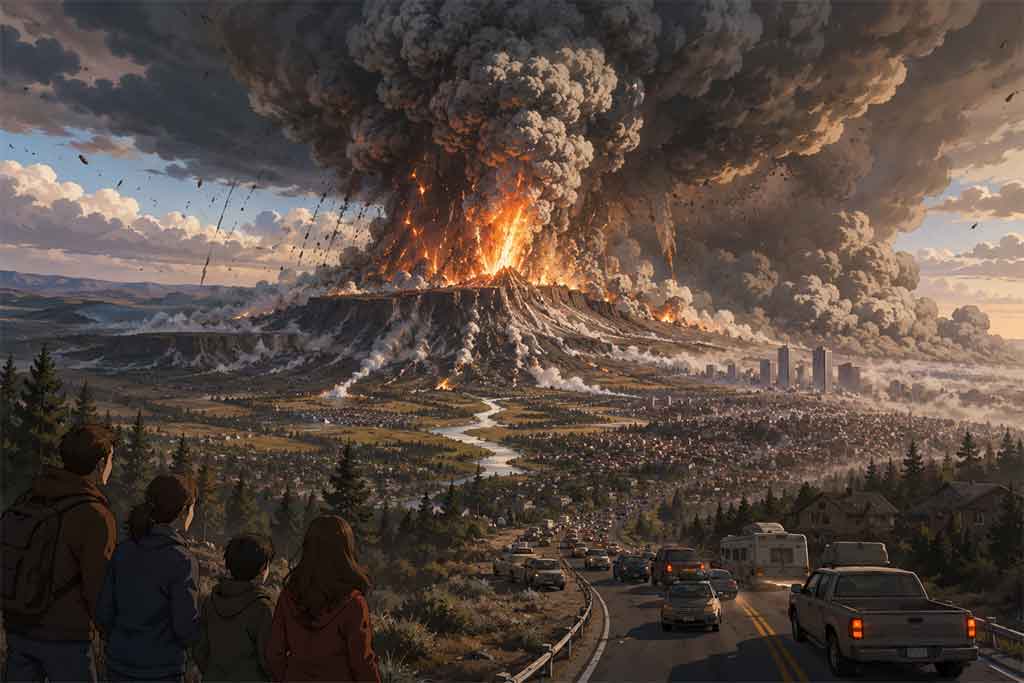
The eruption would begin with a colossal explosion. Think beyond anything recorded in modern history. The blast would send shockwaves across nearby states, flattening forests and destroying infrastructure within hundreds of kilometers.
Cities closest to Yellowstone—like those in Wyoming, Montana, and Idaho—would face immediate devastation. Survival in the direct blast zone would be extremely unlikely.
Pyroclastic Flows
Fast-moving clouds of hot gas, ash, and rock—called pyroclastic flows—would race outward at speeds over 100 km/h. These flows can reach temperatures of 1,000°C, incinerating everything in their path.
This is one of the deadliest aspects of any volcanic eruption, and in Yellowstone’s case, the scale would be enormous.
Ashfall Across the United States
One of the most widespread impacts would be volcanic ash. Within hours, thick ash clouds would rise into the atmosphere and spread across the country.
States like Colorado, Nebraska, and even parts of the Midwest could be buried under several centimeters—or even meters—of ash. Airports would shut down. Roads would become unusable. Breathing the air could become dangerous.
Global Climate Impact
Sunlight Blocked by Ash
A major concern when discussing what would happen if Yellowstone erupted is its global effect. Ash and sulfur dioxide released into the atmosphere would reflect sunlight away from Earth.
This could trigger a “volcanic winter,” where global temperatures drop for months or even years.
Crop Failures and Food Shortages
With less sunlight and cooler temperatures, agriculture would take a major hit. Crops would fail in multiple regions worldwide.
Food supply chains would be disrupted. Prices would spike. Some countries could face severe shortages, leading to humanitarian crises.
Acid Rain and Environmental Damage
The gases released during the eruption could combine with water vapor to form acid rain. This would damage forests, contaminate water supplies, and harm wildlife.
The long-term environmental effects would take years—possibly decades—to recover from.
How Likely Is a Yellowstone Eruption?
Despite the dramatic scenarios, scientists say a supereruption is extremely unlikely in our lifetime. Yellowstone has erupted three times in the past 2.1 million years, with the last major event occurring about 640,000 years ago.
Today, the system is closely monitored by geologists. Earthquake activity, ground movement, and gas emissions are tracked constantly.
So while the question what would happen if Yellowstone erupted is fascinating, it’s not something experts consider an immediate threat.
Economic and Social Consequences
Mass Displacement
Millions of people would need to evacuate. Entire regions could become uninhabitable due to ash contamination and infrastructure damage.
This would create one of the largest refugee crises in modern history—within a developed country.
Economic Collapse in Affected Regions
Industries would shut down. Transportation networks would fail. The cost of rebuilding would reach trillions of dollars.
Global markets could also feel the ripple effects, especially if food production drops significantly.
Healthcare System Overload
Volcanic ash isn’t just messy—it’s dangerous. It can cause respiratory problems, eye irritation, and long-term health issues.
Hospitals would likely be overwhelmed, especially in areas with heavy ashfall.
Could Humanity Survive?
Yes. Even in a worst-case scenario, humanity would survive a Yellowstone eruption. But life would be harder, especially in the short term.
Unlike extreme hypotheticals such as what would happen if the moon exploded, a supereruption wouldn’t destroy the planet. It would disrupt it—severely—but not end it.
Human adaptability is strong. Over time, societies would rebuild, ecosystems would recover, and normal life would gradually return.
How Yellowstone Compares to Other Disasters
When people think about extreme scenarios, Yellowstone often ranks near the top. But it’s just one of many “what if” situations that highlight how fragile our systems can be.
For example, events like what happens if you fall into a black hole explore cosmic dangers, while others like what would happen if mosquitoes went extinct show how even small changes can ripple through ecosystems.
Yellowstone sits somewhere in between—a rare Earth-based event with global consequences.
What Scientists Are Doing Right Now
The good news is that Yellowstone is one of the most studied volcanic systems in the world. Scientists use satellites, seismic sensors, and ground measurements to monitor activity in real time.
If any unusual patterns appear—like increased earthquakes or rapid ground swelling—warnings would likely come well in advance.
This doesn’t eliminate risk, but it gives authorities time to prepare and respond.
What Would Happen If Yellowstone Erupted in the Modern World?
Modern technology would help—but it wouldn’t solve everything. Communication systems could warn people quickly, but evacuating millions is still a massive challenge.
Interestingly, imagining scenarios like what Earth would look like if humans disappeared tomorrow shows how quickly nature can reclaim space. A Yellowstone eruption would create a similar reset in certain regions, though not globally.
In the digital age, recovery might be faster—but the initial shock would still be overwhelming.
Long-Term Environmental Recovery
Regrowth of Ecosystems
Volcanic eruptions can be destructive, but they also create new landscapes. Over time, ash-rich soil can become fertile ground for plant life.
Forests would eventually regrow. Wildlife would return. It might take decades or centuries, but recovery is part of the natural cycle.
Changes in Weather Patterns
The eruption could temporarily alter global weather systems. Jet streams might shift. Rainfall patterns could change.
These changes would gradually stabilize as the atmosphere clears.
Public Myths vs Reality
There’s a lot of misinformation about Yellowstone. Some believe it’s “overdue” for an eruption, but that’s not how geology works.
Volcanoes don’t follow schedules. The idea that an eruption is imminent simply because time has passed isn’t supported by science.
So while asking what would happen if Yellowstone erupted is valid, assuming it will happen soon is not.
Final Thoughts
A Yellowstone eruption would be one of the most powerful natural events humans could experience. It would reshape landscapes, disrupt global systems, and challenge societies in ways we’ve never seen.
But it wouldn’t be the end of the world.
Understanding these scenarios isn’t about fear—it’s about awareness. The more we learn, the better prepared we become.
And in the end, that’s what matters most.