
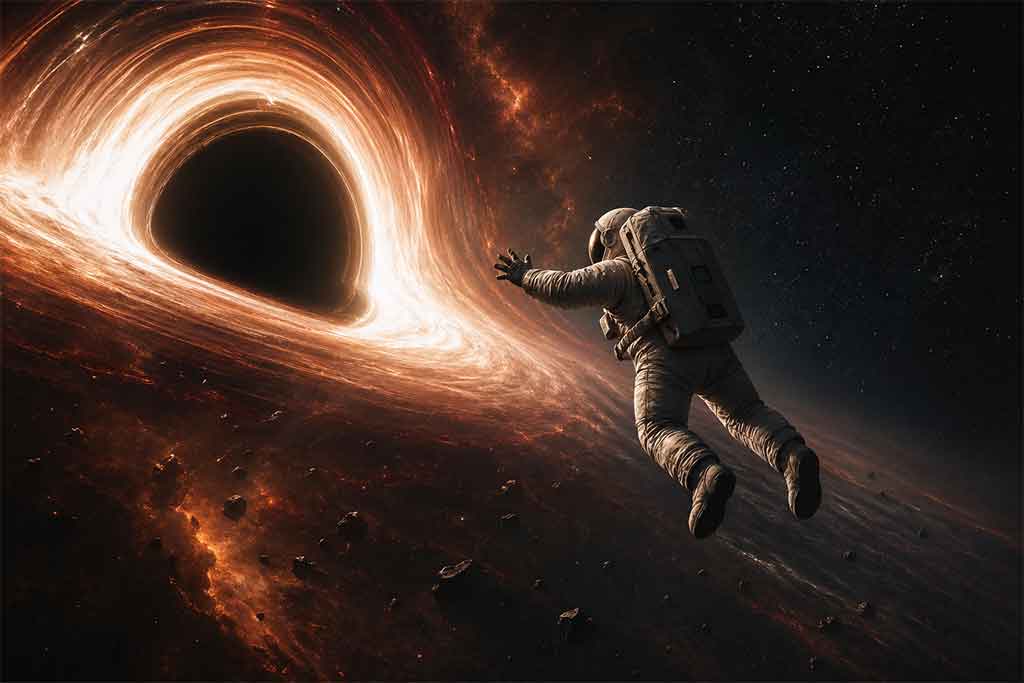

If you fall into a black hole, you don’t simply disappear instantly. The most likely outcome is that you would be stretched, crushed, and ultimately torn apart by extreme gravity in a process scientists call “spaghettification.” Before that happens, you would experience time distortion, intense radiation, and a one-way trip past a boundary called the event horizon, where nothing—not even light—can escape.
That’s the short answer. But the real story behind what happens if you fall into a black hole is far more fascinating, and honestly, a bit unsettling. Let’s walk through it step by step.
Table of Contents
Approaching a Black Hole: It Doesn’t Look Like You Expect
First things first, a black hole isn’t a giant cosmic vacuum cleaner sucking everything in from afar. If you were far enough away, you could orbit it just like you orbit a star or planet. The danger begins when you get too close.
From a distance, a black hole would look like a dark sphere surrounded by a glowing disk of superheated gas called an accretion disk. This disk can shine brighter than entire galaxies because of friction and energy released as matter spirals inward.
As you move closer, gravity becomes stronger and stranger. Light itself bends around the black hole, creating a warped, almost surreal view of the universe behind it.
Crossing the Event Horizon: The Point of No Return
The moment you cross the event horizon is where things get serious. This boundary marks the point where escape is no longer possible. Once you’re inside, every possible path leads deeper into the black hole.
Interestingly, you wouldn’t feel anything special at the exact moment you cross it—at least not immediately. If the black hole is large enough, the transition could feel surprisingly normal.
But to someone watching from far away, it would look like you slow down and freeze at the edge. Time appears to stop for you from their perspective. This is due to extreme gravitational time dilation.
This strange effect on time isn’t totally foreign. Even here on Earth, time can shift slightly depending on gravity and speed. It’s just never this dramatic.
Spaghettification: The Real Danger Begins
Now we get to the part most people are curious about when asking what happens if you fall into a black hole.
As you move deeper, the difference in gravitational pull between your head and your feet becomes enormous. This is called tidal force.
Your feet, being closer to the center, feel a stronger pull than your head. Over time, this stretches your body into a long, thin shape—like spaghetti. At the same time, you’re being squeezed sideways.
This process isn’t instant, but it’s inevitable. Eventually, the forces become so extreme that no material—human or otherwise—can hold together.
It’s not exactly a peaceful end.
What Would You Actually Experience?
Here’s where things get weird.
From your own perspective, you might not notice the outside universe speeding up dramatically. You could, in theory, witness the future of the universe unfold in fast-forward as you fall inward.
But whether that actually happens depends on the size and type of black hole. Smaller black holes would kill you quickly due to stronger tidal forces near the event horizon. Larger ones might allow you to survive longer before things get fatal.
This idea of experiencing time differently is similar in a very distant way to how our bodies react under extreme conditions. For example, the mental and physical distortion described in what happens if you stay up all night for 3 days shows how perception can shift when pushed beyond limits. A black hole just takes that concept to the cosmic extreme.
Can You Reach the Center?
At the center of a black hole lies what’s called a singularity—a point where gravity becomes infinite and the known laws of physics break down.
Can you actually reach it?
According to current physics, yes—but not in any meaningful way. By the time you get close, you’ve already been stretched and destroyed at the atomic level.
So while the idea of reaching the center sounds intriguing, it’s not something you would consciously experience.
What About Information? Do You Truly Disappear?
This is one of the biggest debates in modern physics.
When asking what happens if you fall into a black hole, it’s natural to wonder: do you just vanish forever?
Some theories suggest that information about everything that falls in is somehow preserved on the event horizon. Others suggest it’s lost entirely, which would violate known physical laws.
This puzzle is known as the “black hole information paradox,” and even top scientists are still working on it.
Could You Survive a Black Hole?
Short answer: no.
Longer answer: not with any technology we currently understand.
The combination of radiation, tidal forces, and extreme gravity makes survival impossible. Even if you somehow avoided being stretched apart, the environment itself is too hostile.
It’s a bit like wondering about extreme human scenarios on Earth. For example, what happens if you don’t leave your house for a week explores isolation effects—but in space, isolation comes with lethal physics.
Do All Black Holes Act the Same?
Not exactly.
There are different types of black holes, and your experience would vary depending on which one you encounter.
Stellar black holes, formed from collapsing stars, are relatively small and extremely dangerous. You’d be torn apart quickly.
Supermassive black holes, found at the centers of galaxies, are much larger. Ironically, they might allow you to cross the event horizon without immediate destruction—but the end result is still the same.
What Happens If You Fall Into a Black Hole Compared to Other Extremes?
It’s interesting to compare cosmic extremes with everyday “what if” scenarios. While nothing on Earth comes close, we still like to explore limits.
For instance, what happens if you sit for 10 hours a day shows how gradual strain affects the body. A black hole is the ultimate version of that—except the strain becomes instantly catastrophic.
Or consider something like what happens if you use your phone before bed every night. Small habits can slowly alter your biology. Falling into a black hole is the opposite—everything changes all at once, beyond recovery.
Could Black Holes Be Portals?
This is where science meets speculation.
Some theories suggest black holes could connect to other parts of the universe—or even other universes entirely—through something called a wormhole.
However, there’s no evidence that this actually happens. Even if it did, the journey through a black hole would likely destroy anything trying to pass through.
So while it’s a fun idea for science fiction, it’s not something you should count on.
Final Thoughts
So, what happens if you fall into a black hole?
You cross a point of no return, experience extreme time distortion, and are eventually stretched and destroyed by overwhelming gravity. It’s one of the most extreme fates imaginable in the universe.
Black holes remain one of the biggest mysteries in science. They challenge everything we think we know about physics, time, and reality itself.
And while you’re extremely unlikely to ever encounter one, understanding them gives us a deeper appreciation for just how strange—and powerful—the universe really is.