How to Fix a Door That Swings Open by Itself – You close or partly open a door, walk away, and a few seconds later it starts moving on its own. Annoying? Absolutely. And when it happens every day, even a simple bedroom door opens by itself problem can become surprisingly frustrating.
The good news is that you probably don’t have a mysterious “ghost door.” In most cases, gravity, door alignment, loose hinges, or air pressure is responsible. This guide explains how to fix a door that swings open by itself, starting with simple fixes you can try before calling a professional.
What Causes a Door to Swing Open by Itself?
A normal hinged door should generally stay close to the position where you leave it. When it doesn’t, something is causing the door to move around its hinge axis.
The most common causes include:
- An out-of-plumb door frame
- Loose hinge screws
- Worn or damaged hinges
- A slightly bent hinge pin
- A warped door
- A sloping floor
- Air pressure or drafts
- A door closer or spring hinge that is incorrectly adjusted
The most important distinction is whether the door moves every time, or only when there is airflow.
If it slowly swings open even when all windows are closed and the HVAC system is off, alignment is the first thing to investigate. An out-of-plumb hinge jamb can allow gravity to pull the door toward one side.
How to Fix a Door That Swings Open by Itself
Before changing anything, figure out exactly why your door moves. This prevents you from applying a temporary fix to the wrong problem.
Here are the most useful solutions, how to fix a door that swings open by itself.
1. Tighten the Door Hinge Screws
Loose hinges are one of the easiest problems to fix.
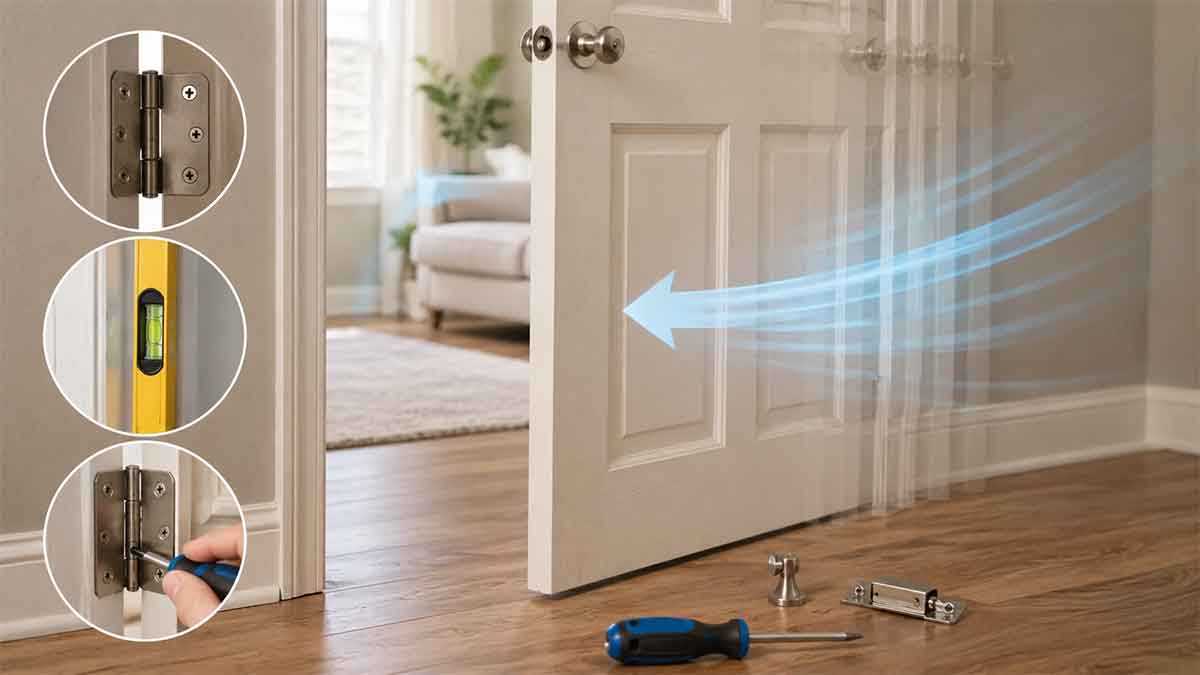
Open the door and inspect all the screws holding the hinges to both the door and the frame. If one or more screws are loose, tighten them firmly with the correct screwdriver.
Pay particular attention to the top hinge. A loose top hinge can allow the door to sag slightly and change the effective hinge alignment.
If a screw simply spins without tightening, the wood around the hole may be stripped.
You can repair a stripped hole by:
- Removing the loose screw.
- Filling the hole with suitable wood material and adhesive.
- Allowing it to set.
- Reinstalling the screw.
For a stronger repair, a longer screw can sometimes reach solid framing behind the jamb, provided the screw is appropriate for the door and frame construction. Loose hinge screws can change the door’s alignment enough to cause unwanted movement.
2. Check Whether the Door Frame Is Plumb
If tightening the hinges doesn’t solve the problem, grab a spirit level.
Place the level vertically against the hinge-side door jamb. The jamb should be as close to perfectly vertical as practical.
If the bubble shows that the jamb is leaning, you’ve likely found the reason your door swings.
A door hanging from a hinge line that isn’t vertical can respond to gravity by moving toward the lower side. This is why an internal door swings open even though nobody is touching it.
You can also test it without a level.
Open the door about halfway and let go.
If it consistently drifts in the same direction, that’s a strong clue that the door or hinge line isn’t properly aligned.
3. Bend the Hinge Pin Slightly
This is a classic DIY solution for a ghost swing door.
The idea is simple: introduce a tiny amount of friction into the hinge so gravity isn’t strong enough to move the door.
To try it:
- Close the door.
- Use a nail or punch to gently drive one hinge pin upward.
- Remove the pin.
- Place it on a hard, stable surface.
- Give the middle of the pin a very slight bend.
- Reinstall the pin.
- Test the door.
Don’t create a sharp kink. You only need a small amount of deformation to increase friction inside the hinge.
If the door still moves, you can repeat the process with another hinge.
This method has long been used for doors that swing open or closed by themselves because the additional friction can counteract the unwanted movement.
Important: Don’t hit the hinge pin aggressively while it’s installed in the hinge. Remove it first and work carefully.
4. Shim the Door Hinge
If the door frame is only slightly out of alignment, hinge shimming can provide a more controlled solution.
A thin shim placed behind a hinge leaf changes the position of that hinge slightly. The goal is to alter the hinge line enough to bring the door closer to plumb.
This is more precise than simply bending a hinge pin, but it requires some trial and error.
A basic process is:
- Determine which direction the door is drifting.
- Choose the hinge that needs adjustment.
- Support the door before loosening the hinge.
- Remove the hinge screws from the jamb side.
- Place a very thin shim behind the hinge leaf.
- Reinstall and tighten the screws.
- Check the door again.
Use very thin material at first. A small change can have a noticeable effect.
If you aren’t comfortable determining which hinge needs adjustment, don’t keep adding shims randomly. Too much adjustment can create uneven door gaps or cause the door to rub.
5. Replace Worn Door Hinges
Sometimes the frame is fine but the hinges aren’t.
Older hinges can develop play, corrosion, damaged knuckles, or other wear. The door may feel loose when you lift it or move it sideways.
Check for:
- Excessive movement around the hinge
- Rust or damaged metal
- Loose hinge pins
- Bent hinge components
- Screws that won’t stay tight
- A door that sags or rubs against the frame
If the hinge itself is worn, replacement is often better than trying to compensate with a bent pin.
For a standard interior door, replacing hinges isn’t usually complicated, but make sure the replacement hinges match the size, corner style, screw-hole pattern, and finish of the existing hardware.
6. Check for Air Pressure and Drafts
Not every door open by itself problem is caused by the hinges.
Air pressure can move a lightweight interior door, especially when there is a significant pressure difference between rooms.
This can happen when:
- An HVAC system turns on
- A bathroom exhaust fan is running
- A kitchen exhaust fan is operating
- A window is open
- Another exterior door is opened
- Strong outdoor wind is creating pressure around the house
Here’s an easy test.
Open the door halfway and watch it with the HVAC system off. Then repeat the test when the HVAC or exhaust fan is running.
If the door only moves when the system is operating, air pressure may be the real culprit.
You can also hold a thin piece of tissue near the door gap to look for noticeable airflow.
7. Use a Door Catch or Stopper
Sometimes you don’t need to correct the underlying alignment.
If you’re renting, don’t want to alter the hinges, or simply need a quick solution, a magnetic door catch, floor stopper, wall stopper, or door stay can keep the door where you want it.
This is particularly useful when:
- The door swings open only occasionally.
- You want it to stay open at a particular angle.
- The frame would be expensive to repair.
- You need a reversible solution.
However, a stopper treats the symptom rather than correcting the underlying alignment problem.
How to Stop a Door Swinging Open on Its Own?
The best solution depends on what is making the door move.
| Problem | Best first solution |
|---|---|
| Loose hinge screws | Tighten or replace screws |
| Door frame out of plumb | Adjust or shim the hinges |
| Worn hinges | Replace hinges |
| Slight unwanted movement | Bend one hinge pin slightly |
| Strong airflow | Reduce pressure or add a catch |
| Door needs to stay open | Install a door stop or stay |
| Major frame misalignment | Re-plumb the frame |
Don’t immediately replace the entire door. A door that swings open is often perfectly usable; the problem may be with the way it’s hanging.
How to Prevent a Door From Swinging Open
Once you’ve fixed the immediate problem, a few simple habits can help prevent it from returning.
Keep hinge screws tight
Check the hinges occasionally, especially if the door receives heavy daily use.
Don’t ignore a sagging door
If the top corner of the door starts dropping or the bottom begins rubbing, investigate early. A small hinge problem can become more difficult to correct if ignored.
Check the frame after major home movement
House settling, renovations, moisture changes, and other structural movement can affect door alignment.
Avoid forcing a misaligned door
If you have to push, lift, or slam a door to close it, don’t keep forcing it. Find out why it’s misaligned.
How to Stop a Door Swinging Open in the Wind
If your main problem is an exterior or back door, wind may be the biggest factor.
A back door swinging open can be particularly troublesome because exterior doors are exposed to stronger pressure differences.
Start by checking whether the latch properly engages the strike plate.
If the door is being pushed open because it isn’t securely latched, adjust the strike plate or repair the latch rather than trying to make the hinges tighter.
For a door that needs to remain open during certain conditions, consider:
- A heavy-duty door stop
- A magnetic catch
- A wall-mounted stopper
- An appropriate door stay
- A properly adjusted door closer
For exterior doors, also check the weatherstripping. Damaged or poorly fitted weatherstripping can affect how the door seals, although it isn’t usually the primary cause of a door that swings open.
What If the Door Swings Closed by Itself?
The same basic principles apply.
A door swings closed by itself when gravity, hardware, or air pressure is pulling it toward the closed position.
Start by checking the hinge-side jamb with a level.
Then inspect the hinges and screws.
If the door is correctly aligned but still closes because it has spring hinges or a door closer, that hardware may actually be doing exactly what it was designed to do.
Spring hinges contain a spring mechanism that provides closing force, while an overhead door closer is specifically designed to close the door.
In that situation, you may need to adjust or replace the hardware rather than modify the frame.
Why Does My Bedroom Door Open by Itself?
A bedroom door opens by itself for the same reasons as any other interior door.
The most likely causes are:
- The hinge-side jamb is slightly out of plumb.
- The hinges are loose.
- The hinge pin creates an imbalance.
- The door or frame has shifted.
- Air pressure is moving the door.
Bedroom doors often reveal the problem because they’re frequently left partly open.
Try opening the door halfway and releasing it. If it slowly travels toward the open position every time, check the hinge alignment before assuming there’s anything unusual happening.
How to Fix a Door That Opens by Itself Without Bending the Hinge Pin
If you don’t want to bend a hinge pin, you have several alternatives.
First, tighten the hinges. This is the simplest option.
Second, check the jamb with a level. If it’s out of plumb, carefully adjusting the hinges with thin shims may correct a minor alignment problem.
Third, replace worn hinges. This makes sense when the hardware itself has excessive play.
Fourth, install a door catch or stopper. This is a good option when you don’t want to modify the door frame.
For a badly misaligned frame, the proper long-term repair may involve removing trim, shimming the jamb, and securing it correctly to the framing. That’s more involved than a typical five-minute DIY repair.
When Should You Call a Professional?
Most minor door-drift problems are DIY-friendly.
However, consider getting professional help if:
- The entire door frame is visibly crooked.
- Several doors in the same area have suddenly developed problems.
- The door frame has moved significantly.
- The door is rubbing badly.
- The wall around the door has noticeable cracks.
- The door won’t latch securely.
- The repair requires removing and resetting the frame.
- You suspect significant structural movement.
A professional can determine whether the problem is isolated to the door or part of a larger framing issue.
Related Home Repair Guides
If you’re dealing with other common home maintenance problems, these guides from What If Corner may also help:
- How to Fix Baseboards With Wood Filler
- How to Fix a Crack in Drywall From Settling Without Making It Worse
- How to Fix a Bad Mud Job on Painted Drywall Without Starting Over
- How to Fix Drywall Tape Bubbles
- Why Is There a Crack in My Ceiling?
- What to Do If the Ceiling Is Leaking
- How to Fix Laminate Flooring on Tiles
Frequently Asked Questions
What causes a door to swing open by itself?
The most common cause is an out-of-plumb hinge-side door jamb. Loose hinges, worn hardware, air pressure, and a sloping floor can also cause unwanted movement.
How do you fix a door that opens by itself?
Start by tightening the hinge screws and checking the jamb with a level. If the frame is slightly misaligned, adjust or shim the hinges. For a minor problem, adding friction with a slightly bent hinge pin can also work.
How do you fix a ghost swing door?
A ghost swing door is simply a door that moves open or closed without being touched. Check the hinge-side jamb for plumb, tighten loose hinges, and correct the alignment. A slightly bent hinge pin can provide a quick fix for minor movement.
How do I stop my door from swinging open in the wind?
First, make sure the latch and strike plate engage properly. If wind pressure is the main problem, a suitable door closer, catch, stay, or stopper can help control the movement.
Why does my door swing open too easily?
A door that swings open too easily may have an out-of-plumb hinge line, loose or worn hinges, or an airflow problem. Check the hinge-side jamb and hardware before replacing the door.
Conclusion
A door that swings open by itself is usually not a mysterious problem. It’s often a simple combination of gravity, alignment, hinge condition, or air pressure.
Start with the easiest checks: tighten the hinge screws, inspect the hinges, and use a level to check the hinge-side jamb. If the frame is only slightly misaligned, hinge shimming or a carefully bent hinge pin may solve the problem.
For a quick solution, a door catch or stopper can keep the door under control. But if the frame is significantly out of plumb or the door has started behaving differently after structural movement, a proper alignment repair is the better long-term answer.
Once you identify the cause, how to fix a door that swings open by itself becomes much simpler—and you can usually solve the problem without buying a new door.